When you take a medication for depression or chronic pain, you expect relief-not confusion, memory lapses, or a racing heart. Yet for many people on tricyclic antidepressants (TCAs) like amitriptyline or nortriptyline, these side effects aren’t rare accidents. They’re predictable, well-documented risks tied to something called anticholinergic burden. This isn’t just a technical term for doctors. It’s a real, measurable danger that can silently erode your brain and heart over time, especially if you’re over 50.
What Is Anticholinergic Burden?
Your body uses acetylcholine, a chemical messenger, to control everything from memory and attention to digestion and heart rhythm. Anticholinergic drugs block this signal. Tricyclic antidepressants are among the strongest offenders. They were designed to boost serotonin and norepinephrine to lift mood, but along the way, they also slam shut acetylcholine receptors. That’s why they’re rated with the highest possible score-3-on the Anticholinergic Cognitive Burden (ACB) Scale. A score of 3 means the drug has
definite, high anticholinergic activity. Compare that to SSRIs like sertraline or escitalopram, which usually score 0 or 1. TCAs aren’t just a little anticholinergic. They’re built for it.
Why Cognitive Decline Is No Accident
Think of your brain as a busy city. Acetylcholine is the traffic controller, keeping signals moving between neurons. When TCAs block it, traffic jams form. Memory fades. Focus slips. People start forgetting names, misplacing keys, or struggling to follow conversations. These aren’t signs of aging-they’re signs of drug-induced brain fog.
A landmark study in
JAMA Internal Medicine followed over 3,400 adults over 65 for seven years. Those taking medications with an ACB score of 3 or higher had a 54% higher risk of developing dementia. And TCAs were the biggest contributors. What’s worse? Some of this damage may not reverse-even after stopping the drug. Doctors now warn that anticholinergic side effects can mimic dementia. A patient on amitriptyline for years might be diagnosed with Alzheimer’s, when the real culprit is the medication. When the drug is stopped, many see improvement. That’s not dementia. That’s drug toxicity.
The Heart Risks Are Just as Serious
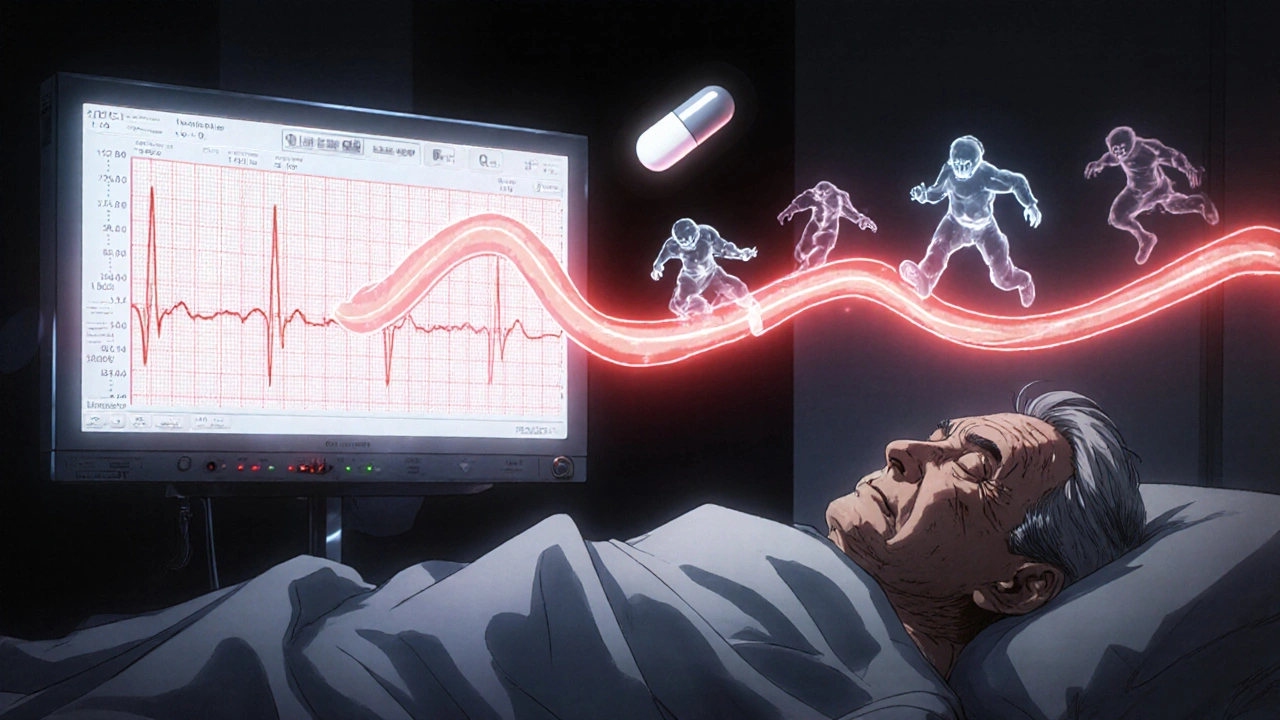
Your heart runs on electrical signals. TCAs interfere with those signals too. They act like class 1A antiarrhythmics-drugs meant to control irregular heartbeats-but without the safety controls. This means they can prolong the QT interval on an ECG, a sign your heart is taking longer than normal to recharge between beats. Prolonged QT can trigger dangerous rhythms like torsades de pointes, which can lead to sudden cardiac arrest.
Amitriptyline, in particular, can stretch the QRS complex on an ECG by 10-25% at normal doses. In overdose, that jump can hit 50%. Even at therapeutic levels, TCAs reduce heart muscle strength by 15-20% and make the heart more irritable. For someone with existing heart disease, high blood pressure, or an older heart, this is a ticking time bomb. Studies show TCAs carry about three times the risk of arrhythmias compared to SSRIs. Amitriptyline alone is linked to 2.8 times higher risk of QT prolongation than sertraline. One patient on a support forum described going to the ER after three weeks on amitriptyline-palpitations, dizziness, and a dangerously prolonged QT interval. That’s not an outlier. It’s a known reaction.
Who’s Most at Risk?
It’s not just the elderly. While older adults are the most vulnerable, anyone over 50, especially those on multiple medications, is at higher risk. Polypharmacy-taking five or more drugs-is common in chronic conditions like depression, diabetes, arthritis, or bladder problems. Many of those other drugs also have anticholinergic effects: over-the-counter sleep aids like diphenhydramine (Nytol®), allergy pills like chlorphenamine (Piriton®), or bladder medications like oxybutynin. Add one TCA to that mix, and your total ACB score can easily hit 5 or 6. That’s not just risky. That’s dangerous.
A 2022 survey by the National Council on Aging found that 68% of people over 65 on TCAs reported two or more anticholinergic side effects. Dry mouth, constipation, blurred vision, urinary retention-these are the common ones. But cognitive and cardiac risks are the silent killers. And they’re often ignored until it’s too late.
Why Are TCAs Still Prescribed?
They work. For some people with treatment-resistant depression, or severe neuropathic pain, TCAs are still effective. They’ve been around since the 1950s, and they’ve helped millions. But that doesn’t mean they’re the best choice anymore. Modern alternatives like SNRIs (duloxetine, venlafaxine) and newer antidepressants have similar pain-relieving and mood-boosting effects-with ACB scores of 0 or 1. No cognitive fog. No QT prolongation. Fewer side effects. The problem? Many doctors still default to amitriptyline because it’s cheap and familiar. But guidelines from NICE and the Beers Criteria now clearly say: avoid TCAs in adults over 65 unless all other options have failed.
What Should You Do?
If you’re on a TCA, don’t stop suddenly. Withdrawal can cause dizziness, nausea, and rebound anxiety. But do ask your doctor these questions:
- What’s my total anticholinergic burden? (Add up all your meds-prescription and OTC.)
- Can we switch to an SNRI or another antidepressant with lower risk?
- Have you checked my ECG for QT prolongation?
- Are any of my other medications (sleep aids, antihistamines, bladder pills) adding to this burden?
Many UK clinics now use digital tools that automatically calculate your ACB score when you fill a prescription. If yours doesn’t, ask for a full medication review. Deprescribing programs in NHS Somerset showed that 78% of older patients successfully reduced their anticholinergic burden, and 63% saw cognitive improvements within six months.
The Future Is Changing
Prescribing of TCAs for depression has dropped from 15% in 2000 to under 5% in 2020. New antidepressants approved since 2010 almost all have zero anticholinergic activity. AI-powered systems are being piloted in UK hospitals to flag high-risk drug combinations before they’re even written. The message is clear: the risks outweigh the benefits for most people.
TCAs aren’t evil drugs. But they’re outdated tools in a world with safer options. If you’re taking one, especially if you’re over 50, it’s time to have a real conversation about your long-term brain and heart health. What you’re experiencing-forgetfulness, confusion, heart palpitations-might not be your body aging. It might be your medication.
Are tricyclic antidepressants still used today?
Yes, but rarely as a first choice. TCAs like amitriptyline and nortriptyline are still prescribed for treatment-resistant depression and certain types of chronic nerve pain, especially when newer antidepressants haven’t worked. However, due to their high anticholinergic burden and cardiac risks, guidelines now recommend them only after safer alternatives like SNRIs or SSRIs have failed.
Can stopping a TCA reverse cognitive decline?
In many cases, yes. Studies show that when people stop high-anticholinergic medications like TCAs, cognitive function can improve-sometimes significantly. One study found that after 12 months of deprescribing, older adults saw an average 2.7-point increase in Mini-Mental State Examination (MMSE) scores. But if the brain has been exposed for many years, some damage may be permanent. The earlier you stop, the better the chance of recovery.
How do I know if my medication has anticholinergic effects?
Check the Anticholinergic Cognitive Burden (ACB) Scale. Amitriptyline, nortriptyline, diphenhydramine (Nytol®), chlorphenamine (Piriton®), and oxybutynin all score a 3-highest risk. SSRIs like sertraline and escitalopram score 0 or 1. You can ask your pharmacist for a free ACB calculator, or request a full medication review with your doctor. Many electronic health records now flag these drugs automatically.
Is amitriptyline worse than other TCAs?
Amitriptyline and nortriptyline both have the same maximum ACB score of 3, meaning they’re equally potent at blocking acetylcholine. But amitriptyline has stronger effects on the heart-it’s more likely to prolong the QT interval and cause arrhythmias. Nortriptyline is slightly less sedating and may be preferred for older adults, but neither is considered safe for long-term use in people over 65.
What are safer alternatives to TCAs for depression and pain?
For depression, SSRIs like sertraline or escitalopram and SNRIs like duloxetine or venlafaxine are preferred. Duloxetine also works well for nerve pain. For chronic pain, gabapentin, pregabalin, or non-drug options like cognitive behavioral therapy (CBT) and physical therapy are effective with no anticholinergic risk. Always discuss alternatives with your doctor before making any changes.





Kaleigh Scroger
I've been on amitriptyline for chronic back pain for 8 years and I swear my memory has been slipping since I started. I forget where I put my keys, what day it is, sometimes even my own phone number. I thought I was just getting old until I read this. My doctor never mentioned anticholinergic burden. I'm scheduling an appointment this week to talk about switching to duloxetine. If you're on a TCA and feeling foggy, don't ignore it. It's not aging it's the drug
Elizabeth Choi
Statistically speaking the JAMA study cited has a 95% confidence interval that overlaps with other studies showing no significant dementia risk. Also the ACB scale is not validated for long term cognitive outcomes. Correlation is not causation. Just saying
Allison Turner
So you're telling me my grandma's forgetfulness isn't dementia but just her meds? Wow. That's a lot of blame to put on doctors. I mean sure maybe they're lazy but people take these pills for a reason. If you're too weak to handle a little dry mouth and brain fog then maybe you shouldn't be on anything at all
Darrel Smith
This is the single most important post I've read in years. I'm not just talking about my own health I'm talking about my mom. She was on nortriptyline for 12 years. She started forgetting my name. She stopped cooking. She forgot how to use the microwave. We thought it was Alzheimer's. Then her new doctor stopped the meds. Within three months she was back to baking pies and calling me every Sunday. I'm telling everyone I know. If you're on a TCA you're not aging you're being poisoned. And the medical system is letting it happen
Aishwarya Sivaraj
Hi I'm from India and my uncle took amitriptyline for neuropathy. He got so confused he stopped recognizing his own children. We thought it was dementia but the doctor said it was the medicine. He switched to pregabalin and now he's laughing again. I think in our culture we dont talk enough about side effects. We just take pills because doctors say so. But the body speaks if we listen. Thank you for writing this
steve stofelano, jr.
It is with profound respect for the medical literature and the ethical imperatives of patient safety that I acknowledge the compelling evidence presented herein regarding the anticholinergic burden associated with tricyclic antidepressants. The data presented in JAMA Internal Medicine and corroborated by the Beers Criteria represent a paradigm shift in pharmacological stewardship. It is incumbent upon clinicians to prioritize deprescribing protocols and to engage in shared decision-making with patients over the age of 50. The cost of inaction is not merely clinical but existential
Savakrit Singh
TCAs = bad. SSRIs = good. End of story. 😔💔 But seriously folks if you're on amitriptyline and your heart is doing the cha-cha you need to talk to your doctor. #AnticholinergicAwakening #DontBeAScientificControlGroup
Cecily Bogsprocket
I just want to say to anyone reading this who's scared or confused - you're not alone. I was on nortriptyline for depression and I felt like my brain was wrapped in cotton. I thought I was broken. But when I talked to my doctor and switched to escitalopram it was like someone turned on the lights. You don't have to suffer in silence. Your brain matters. Your heart matters. And you deserve to feel like yourself again
Jebari Lewis
As a medical researcher I've reviewed dozens of studies on anticholinergic drugs. The data is overwhelming. But what's more disturbing is the institutional inertia. Why are we still prescribing TCAs in 2025? Because they're cheap. Because doctors are overworked. Because pharmaceutical reps still push them. We need systemic change. Not just individual switches. We need mandatory ACB scoring in all EHRs. We need public awareness campaigns. We need to treat this like the public health crisis it is
Emma louise
Oh great another liberal anti-drug scare tactic. People have been taking TCAs for decades and we're still here. Maybe your grandma's memory went because she watched too much TV and didn't do crossword puzzles. Not because of a $5 pill. Wake up. Big Pharma doesn't want you to know how good these drugs are. They want you on expensive new SSRIs that cost 10x more
sharicka holloway
my sister switched from amitriptyline to sertraline and she says she feels like she got her brain back. no more brain fog no more dry mouth. she even started painting again. if you're on a TCA and you're tired of feeling like a zombie - talk to your doc. it's not weak to ask for help. it's brave
Alex Hess
This is just another case of medical virtue signaling. You people are so obsessed with minimizing every possible risk you've turned healthcare into a risk-free fantasyland. TCAs work. They've helped millions. If you're too fragile to handle a little cognitive blip then maybe you shouldn't be on medication at all. Let people make their own choices instead of pushing your woke pharmaceutical agenda
Leo Adi
In India we have a saying: 'The medicine that cures may also blind.' This post reminds me of my uncle. He took amitriptyline for pain. He stopped recognizing his own garden. We changed his meds. He remembered the names of his roses again. Sometimes the quietest poison is the one in the bottle with the doctor's stamp
Melania Rubio Moreno
wait so you're saying my forgetfulness is from my meds not from my 4 kids and 2 jobs? hmm maybe i should stop taking my little blue pill. i mean i dont want to get alzheimers before i turn 50 lol
Gaurav Sharma
Highly concerning. I have reviewed the pharmacokinetic profiles and QT prolongation data. This warrants immediate regulatory review. Patient safety is not negotiable. I recommend immediate cessation of TCA prescriptions for patients over 50. I will be submitting a formal complaint to the FDA.