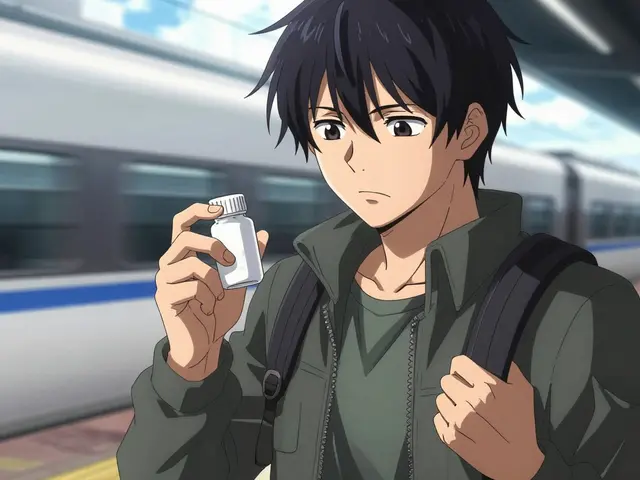

Every year, millions of people take generic medicines because they’re affordable, effective, and widely available. But what if the pill in your bottle isn’t what it claims to be? Counterfeit generic drugs are a growing threat - and they don’t always look fake. Some look identical to the real thing. The only way to know for sure is to check the packaging and labeling - and understand what to look for.
Counterfeiters know this. They copy packaging down to the font size of the expiration date. They use the same colors, same logos, even same batch numbers. But they don’t copy the active ingredients - or they get them wrong. That’s when things get dangerous. Fake metformin can cause kidney failure. Fake antibiotics might not work at all, letting infections spread. And in some cases, counterfeit pills contain deadly substances like fentanyl.
Overt features are what you can see with your own eyes. These include:
Covert features need a little help - like a UV light. These aren’t meant for consumers. But pharmacists and inspectors use them daily:
Track-and-trace systems are the most reliable. Since 2019, the European Union requires every prescription medicine to have a 2D data matrix code. In the U.S., the Drug Supply Chain Security Act (DSCSA) requires the same by November 2023. Each code is unique - like a fingerprint for that pill bottle. When you scan it, the system checks if it’s been registered in the national database. If it’s not, it’s flagged as suspicious.
But here’s the catch: not all generics follow the rules. A 2023 report found that 35-45% of generic medicines still lack proper serialization. That’s because small manufacturers can’t afford the systems. So even if the packaging looks perfect, you can’t always trust the code.
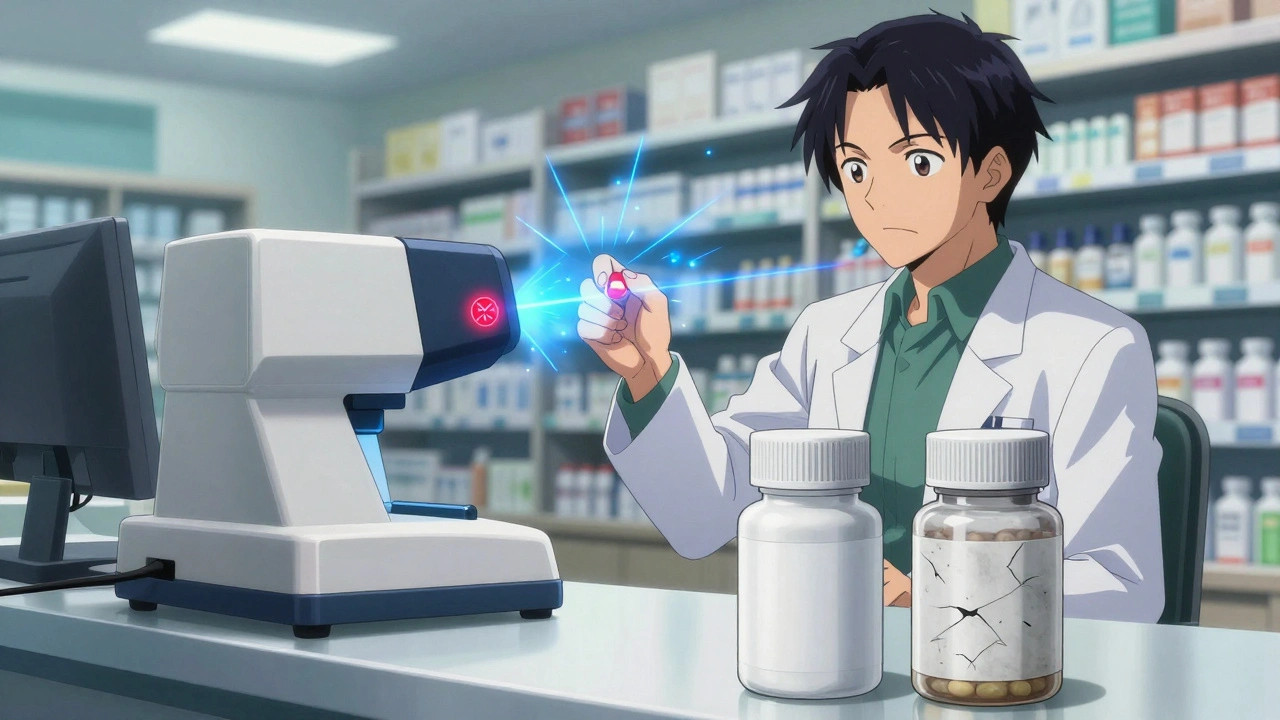
NIR spectroscopy - devices like the Thermo Fisher TruScan® RM - shine infrared light on a tablet and measure how it reflects. Fake pills have different chemical structures. Even if they look identical, the reflection pattern is off. These devices work in 10-30 seconds, cost around $15,000-$30,000, and catch 92-97% of counterfeits. They’re especially good at spotting differences in coatings and moisture levels.
Raman spectroscopy - like the B&W Tek NanoRam® - uses laser light to identify specific molecules. It’s great for detecting the wrong active ingredient. But it struggles with dark pills because the color interferes with the laser. Accuracy: 88-94%.
One pharmacist in Ohio told Drug Topics magazine: “I had a patient on metformin. The packaging looked perfect. The barcode scanned fine. But the NanoRam® screamed ‘fake.’ The active ingredient was 12% off. If we hadn’t tested it, the patient could’ve developed lactic acidosis.”
These tools aren’t in every pharmacy. But regional verification centers - now set up in 22 U.S. states - let smaller pharmacies send samples for testing. It’s free or low-cost. If your local pharmacist says they can’t verify a drug, ask if they can send it out.
Trust your gut. If something feels off - it probably is.
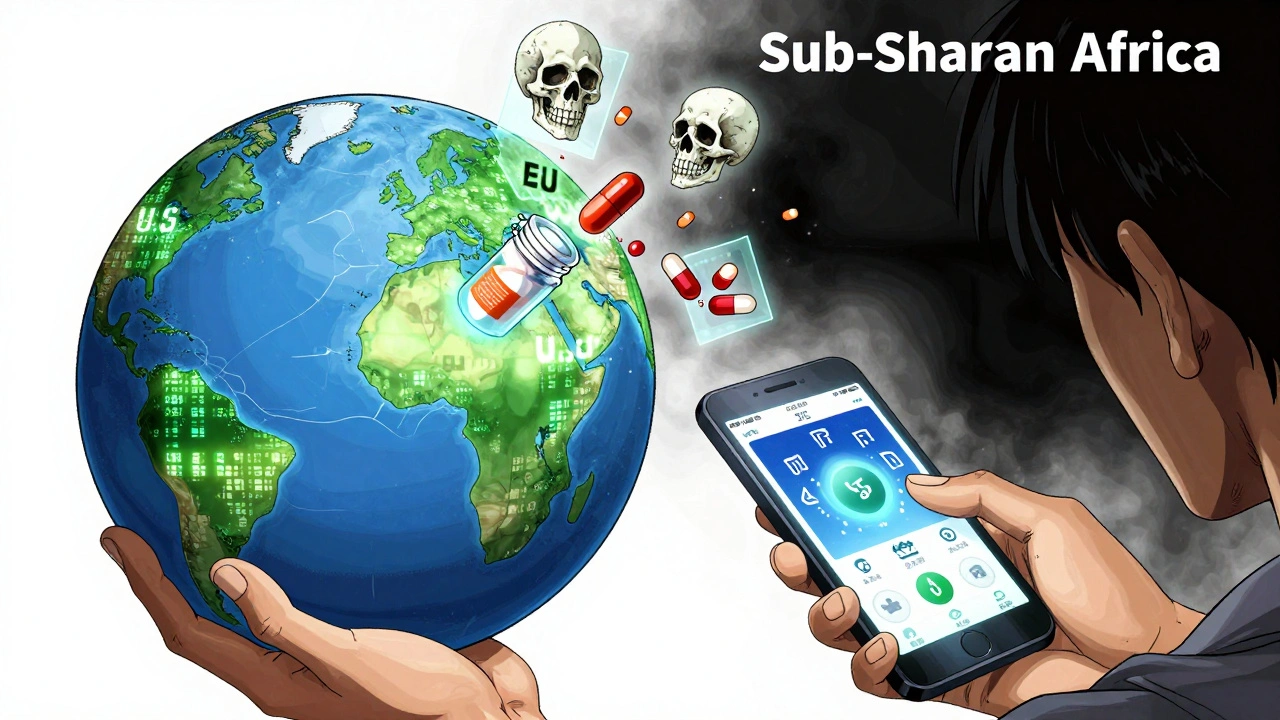
The WHO estimates that 10% of global medicines are counterfeit. In some low-income countries, that number jumps to 30%. And generics are the most vulnerable. They’re cheaper to produce - and cheaper to fake.
There’s no global standard. The EU’s system has 98% compliance. Southeast Asia? Only 45%. That means a fake pill made in India could pass through Europe undetected - and end up in your medicine cabinet.
In the U.S., the Generic Pharmaceutical Association is pushing for 100% serialization of all generics by 2026. A $500 million fund is being set up to help small manufacturers afford the tech.
And new tools are coming. Thermo Fisher’s 2023 TruScan® RM Gen3 cuts analysis time to just 5-15 seconds. AI-powered systems are being tested to combine data from packaging, spectroscopy, and blockchain to flag fakes in real time. Gartner predicts that by 2028, 70% of verification will use AI-driven multi-method checks.
The truth is: the system isn’t perfect. But it’s better than it was. And you’re not powerless. You can ask questions. You can compare bottles. You can demand proof. And if you’re ever unsure - don’t take the pill. Return it. Report it.
Counterfeit drugs kill. But awareness saves lives.
Look for inconsistencies: smudged print, uneven edges, mismatched fonts (especially on expiration dates), or a box that feels thinner than usual. Real packaging is precise. Fake packaging often has slight errors - like a logo that’s slightly off-center or a barcode that’s too wide. Compare it to a previous bottle. If it looks different, even in small ways, it could be counterfeit.
No. While branded drugs almost always have advanced security, many generic manufacturers skip them to save money. In the U.S. and EU, prescription generics are required to have unique serial codes under DSCSA and FMD rules - but not all have holograms or UV ink. Always assume the lowest level of protection unless you know otherwise. If you’re unsure, ask your pharmacist what features are on that specific batch.
Some apps can help, but they’re not reliable for generics. A 2022 survey found that barcode scanners fail 40-50% of the time with generic drugs because serialization isn’t consistent across manufacturers. Even if the code scans, it doesn’t guarantee the medicine inside is real. These apps work best with branded drugs that have strict tracking. Don’t rely on them alone - use them as a first step, not the final check.
Don’t take it. Return it to your pharmacy immediately. Ask them to report it to the manufacturer and local health authorities. In the U.S., you can also report it to the FDA’s MedWatch program. Keep the packaging - it’s critical evidence. If you’ve already taken the medicine and feel unwell, seek medical help right away. Fake drugs can cause serious harm - even death.
Generics are cheaper to produce - and cheaper to fake. Manufacturers of branded drugs invest heavily in security features because their reputation is on the line. Generic makers often operate on thin margins and may cut corners. Also, generics pass through more distribution points (5-7 vs. 3-4 for branded), giving counterfeiters more chances to intercept and replace them. The result? Higher risk, lower protection.
No. These devices cost $15,000-$50,000 and require training to use properly. They’re used only by hospitals, pharmacies, and regulatory agencies. But if you’re concerned about a medicine, ask your pharmacist if they have access to one. Many regional verification centers offer free testing for suspicious drugs. You don’t need to own the tool - just know how to ask for help.
Only buy from websites that require a prescription and are licensed by your country’s pharmacy board. In the U.S., look for the VIPPS seal (Verified Internet Pharmacy Practice Sites). The WHO estimates that 50% of online pharmacies are illegal - and 80% of the drugs they sell are fake. Never buy from sites that don’t ask for a prescription, or that ship from unknown countries. The risk isn’t worth it.
Charlotte Collins
The packaging on my last metformin bottle had a slightly off-center logo and the expiration date font was wider than usual. I thought it was just a bad print run until I read this. Now I keep a previous bottle for comparison. Small details matter more than we think.
It’s not paranoia - it’s precision. And if your pharmacy can’t answer why the label changed? Walk out. Your life isn’t a gamble.
amit kuamr
In India we get generics from everywhere. Some look perfect. Some are just colored powder in foil. No UV ink no barcode no nothing. We check by taste sometimes. Fake metformin tastes bitter real one is chalky sweet. Not scientific but works when no other option.
Government doesn't care. Pharmacies don't care. Only you care. So learn to look. Even if you're poor you can still be smart.
elizabeth muzichuk
I can't believe people still trust pharmacies without demanding proof. You're not a customer - you're a patient. And patients deserve better than lazy assumptions.
My sister took fake antibiotics and ended up in septic shock. The pharmacy said 'it was from a different distributor.' That's not an excuse - that's negligence.
Stop being passive. Ask for the serial number. Ask for the scan. Ask for the UV test. If they hesitate - take your business elsewhere. And if they fire you for asking? File a complaint. This isn't about convenience - it's about survival.
Debbie Naquin
The epistemological crisis in pharmaceutical verification isn't about technology - it's about distributed epistemic authority.
When the supply chain is fragmented and serialization is optional, the consumer becomes the final epistemic agent - forced to adjudicate truth without access to the underlying ontological markers.
Barcodes are semiotic placeholders. Spectrometry is instrumental verification. But without institutional trust - the entire system collapses into probabilistic guesswork.
What we're witnessing isn't counterfeit medicine - it's the erosion of epistemic infrastructure. And the most dangerous part? We've normalized it.
Erin Nemo
Just scanned my bottle and it checked out - but I still held it up to the light. Found a tiny smudge on the hologram. Called my pharmacist. They sent it out for testing. Turned out fake. Saved me from a bad reaction.
Don’t skip the steps. Even if it’s a hassle. Your body will thank you.
ariel nicholas
Oh wow - so now we’re supposed to carry a $30,000 spectrometer in our purse? Or wait - maybe we should just stop taking medicine altogether? Because clearly, the only safe drug is the one made in a U.S. lab with a 12-step verification process and a U.S. government stamp.
Meanwhile, China and India are feeding the world with affordable meds - and you people are panicking over font sizes? Get a grip. You’re not in a spy movie. You’re in a country where you can buy insulin for $35 - and you’re complaining about a barcode?
Stop being entitled. Start being grateful. Or move to Europe - where your meds cost $500 and you still can’t verify them.
Rachel Stanton
For anyone new to this - start with the basics: compare your current bottle to your last one. Even if it’s just the spacing between letters. That’s step one.
If your pharmacist doesn’t have a UV light? Ask if they can send it to a regional verification center. Most states have them - free or low cost.
And if you’re worried about cost? Ask for samples from the manufacturer. Many offer them. You’re not being difficult - you’re being responsible.
You’re not alone in this. We’ve all been there. Ask. Advocate. Stay calm. But don’t stop asking.
Amber-Lynn Quinata
My grandma took a fake blood pressure pill and nearly died 😭
She didn’t know how to check anything. She trusted the pharmacy. She trusted the price. She trusted the label.
Now I keep a UV pen in my medicine cabinet. I scan everything. I take pictures of the packaging. I send them to my pharmacist. I cry every time I think about how close we came.
Don’t wait until it’s too late. Check it. Now. Please. 💔
Scotia Corley
The assertion that counterfeit generics are a growing threat is misleading. The FDA’s own data shows that the incidence of counterfeit drugs in the U.S. supply chain remains below 0.01%.
Meanwhile, the narrative of widespread fraud serves to justify regulatory overreach, increased costs for manufacturers, and the erosion of consumer autonomy.
What is truly dangerous is the manufactured fear that leads patients to distrust legitimate, FDA-approved generics - the very drugs that make chronic care accessible to millions.
Focus on real threats: non-compliance, under-dosing, and poor adherence. Not font size.