

This tool calculates your risk of tacrolimus neurotoxicity based on key factors discussed in the article.
When you get a new organ, the goal is simple: keep it alive. But for many transplant recipients, one of the most common drugs used to prevent rejection - tacrolimus - comes with a hidden cost. Neurotoxicity isn’t rare. It’s common. And it doesn’t always show up in blood tests.
Tremor is the first sign for most people. It’s not just a slight shake. It’s the kind that makes holding a coffee cup impossible, typing on a keyboard frustrating, or buttoning a shirt a battle. One patient described it as ‘having a tiny electric current running through my hands all day.’ This happens in 65-75% of people who develop neurotoxicity, according to a 2023 review of over 2,000 transplant cases.
Headache is the second most frequent symptom. Not a normal tension headache. This is a deep, constant pressure behind the eyes or at the base of the skull that doesn’t respond to ibuprofen or rest. Patients on transplant forums say it’s worse than migraines - it lingers for weeks, even when tacrolimus levels are ‘in range.’ One liver transplant recipient wrote: ‘I thought it was stress. Then my neurologist looked at my chart and said, “That’s tacrolimus.”’
Other symptoms creep in quietly: tingling in fingers or toes, trouble sleeping, feeling dizzy when standing up, or suddenly stumbling while walking. Some get confused, forget words, or see double. These aren’t ‘just stress’ or ‘normal post-surgery stuff.’ They’re signs your brain is reacting to the drug meant to save your new organ.
Doctors check tacrolimus blood levels to make sure they’re between 5 and 15 ng/mL - depending on whether you had a kidney, liver, or heart transplant. But here’s the problem: you can have a level of 7.2 ng/mL - perfectly within range - and still have severe tremors. Or you can be at 14 ng/mL and feel fine.
Research from the Mayo Clinic and the University of Toronto shows that blood levels alone can’t predict who will get neurotoxicity. In fact, one study found no significant difference in average tacrolimus levels between patients who developed neurotoxicity and those who didn’t. Why? Because the drug doesn’t affect everyone the same way.
Your genes matter. A gene called CYP3A5 controls how fast your body breaks down tacrolimus. If you’re a ‘rapid metabolizer’ (about 20-30% of people, especially those of African or Asian descent), your body clears the drug quickly. To stay in range, you’re given higher doses - which means more of the drug crosses into your brain. That’s why some patients on the same dose have wildly different side effects.
Even more surprising: your electrolytes play a role. Low sodium or low magnesium can make neurotoxicity worse. One study found that correcting these imbalances alone helped 28% of patients avoid having to lower their tacrolimus dose.
Not everyone gets neurotoxicity - but some groups are far more likely to. Liver transplant patients have the highest risk: about 35.7% develop symptoms. Kidney recipients follow at 22.4%. Heart and lung transplant patients are less affected, but still at risk.
Age matters too. People over 60 are more likely to develop tremors and confusion. But it’s not just age. If you’ve had a previous episode of neurological side effects from any medication - like antiseizure drugs, antibiotics, or even certain antidepressants - your brain may be more sensitive.
And here’s something rarely discussed: drug interactions. If you’re on tacrolimus and also take antibiotics like linezolid, pain meds like midazolam, or even antipsychotics like risperidone, your risk of seizures or severe brain fog jumps. Many patients don’t realize these drugs are mixing dangerously with their transplant meds.
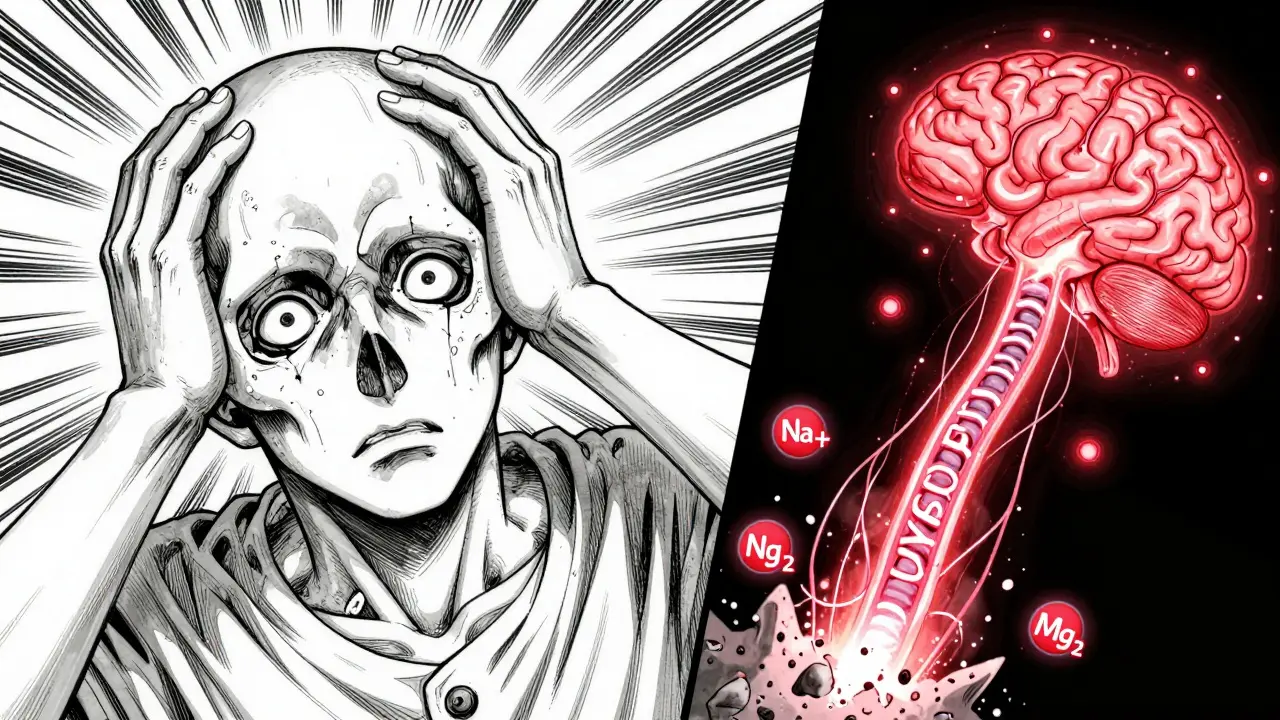
Most cases are mild - tremor and headache that improve with small dose changes. But in 1-3% of patients, something more dangerous happens: Posterior Reversible Encephalopathy Syndrome, or PRES.
PRES shows up on MRI scans as swelling in the back of the brain. Symptoms include sudden vision loss, seizures, confusion, or loss of consciousness. It’s rare, but it’s life-threatening. And it can happen even when tacrolimus levels are ‘normal.’
Another rare but serious condition is central pontine myelinolysis - a breakdown of the brain’s protective insulation. Autopsy studies show it occurs in up to 17% of liver transplant patients who died with neurological symptoms. It’s often missed until it’s too late.
These aren’t theoretical risks. They’re documented in case reports and hospital records. The FDA added a specific neurotoxicity warning to tacrolimus labels in 2020 after tracking over 12,000 adverse events.
There’s no magic fix. But there are proven steps:
Many patients report symptom relief within 3-7 days of adjusting their dose. One man reduced his tacrolimus from 0.1 mg/kg to 0.07 mg/kg and saw his tremor vanish in 72 hours - without his body rejecting the kidney.
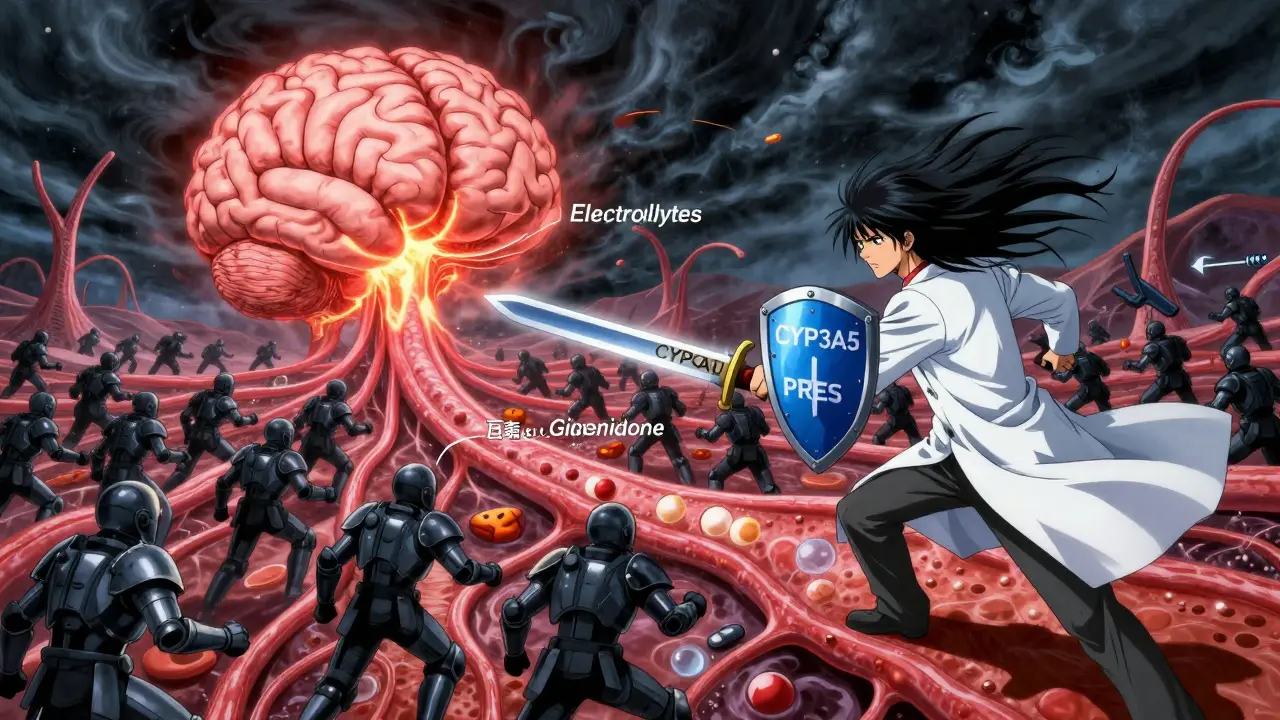
The transplant community knows this is a problem. The American Society of Transplantation released its first-ever neurotoxicity guideline in 2023, urging routine neurological checks in the first 30 days after transplant.
And there’s hope on the horizon. A new drug called LTV-1 is in phase 2 trials. Designed to barely cross the blood-brain barrier, it could offer the same rejection protection as tacrolimus - without the brain fog or tremors. If it works, it could replace tacrolimus by 2027.
Until then, the best defense is awareness. Your blood level isn’t the whole story. Your genes, your electrolytes, your other meds, and your symptoms matter just as much. Don’t let anyone tell you it’s ‘just in your head.’ If your body is telling you something’s wrong - listen.
Yes. Many patients develop tremors, headaches, or confusion even when their tacrolimus blood level is within the recommended range (5-15 ng/mL). This happens because individual differences in how the drug crosses the blood-brain barrier, genetic factors like CYP3A5 metabolism, and electrolyte imbalances can trigger neurotoxicity regardless of blood concentration.
Most patients see improvement within 3 to 7 days after reducing the tacrolimus dose or switching medications. Tremor and headache often resolve faster - sometimes within 48 hours. More severe symptoms like confusion or seizures may take longer, and in rare cases, full recovery can take weeks. Early intervention is key to preventing lasting damage.
Cyclosporine causes neurotoxicity in about 15-20% of patients, compared to 20-40% with tacrolimus. So yes, it’s generally less likely to cause tremors or headaches. But it carries a higher risk of organ rejection - up to 20-30% more than tacrolimus - and can cause more kidney damage over time. The choice depends on your individual risk profile and transplant type.
Yes. Drugs like linezolid (an antibiotic), midazolam (a sedative), propofol (used in anesthesia), and certain antipsychotics like risperidone can increase the risk of seizures or severe neurological side effects when taken with tacrolimus. Always give your transplant team a complete list of all medications - including over-the-counter and herbal supplements - to avoid dangerous interactions.
If you’re experiencing unexplained neurotoxicity or if your dose keeps needing adjustment, yes. The CYP3A5 gene tells your body how quickly it breaks down tacrolimus. If you’re a rapid metabolizer, you may need a higher dose - which increases brain exposure and neurotoxicity risk. Studies show genotype-guided dosing can reduce neurotoxicity by 27%. While not yet standard everywhere, it’s available at most major transplant centers.
If you suddenly develop vision changes, seizures, confusion, or severe headaches with high blood pressure, seek emergency care immediately. PRES is rare but serious. It requires urgent MRI scanning and often immediate reduction or discontinuation of tacrolimus. With prompt treatment, most patients recover fully - but delays can lead to permanent brain damage.



sam abas
Okay so i read this whole thing and honestly? The part about CYP3A5 being the real culprit? That’s wild. I’ve been on tacrolimus for 8 years post-kidney transplant and my levels are always ‘in range’ but i’ve had tremors since day 3. My doc just said ‘it’s normal.’ Well guess what? I finally got tested last year and i’m a rapid metabolizer. They upped my dose thinking i was underdosed but that just made the brain fog worse. Turns out i need LOWER doses than average because my body burns it too fast and the excess crosses the BBB. Why isn’t this standard testing? Why do we still treat everyone like a lab rat with the same numbers?
John Pope
Let’s be real here - tacrolimus isn’t the villain. It’s the price of survival. But the medical establishment’s refusal to acknowledge neurotoxicity as a legitimate, quantifiable phenomenon is the real tragedy. We’re treating a pharmacodynamic paradox like it’s a psychiatric side effect. ‘It’s just stress’ - said the guy who’s never had a transplant. The blood-brain barrier isn’t a static wall. It’s a dynamic sieve shaped by genetics, electrolytes, and gut microbiome. And yet, we still rely on a 1980s-era therapeutic window. The future isn’t cyclosporine. It’s personalized pharmacokinetic modeling. AI-driven dosing algorithms that integrate CYP3A5, serum albumin, and even circadian rhythm. We’re not managing toxicity. We’re still guessing.
Clay .Haeber
Oh wow. A whole essay about how your hands shake and you get headaches. Groundbreaking. Next up: ‘The Horrifying Truth About Aspirin Causing Mild Dizziness.’
Meanwhile, people who actually have real problems - like cancer or sepsis - are over here surviving while you’re posting 12 paragraphs about your ‘constant pressure behind the eyes.’
Also, ‘electrolytes fix it’? You sound like a wellness influencer who just watched a 5-minute YouTube video. Get a grip. You’re alive. Be grateful. Or at least stop making neurotoxicity sound like a Netflix documentary.
Priyanka Kumari
This is such an important and well-researched post. Thank you for sharing your experience and the science behind it.
I’m a transplant nurse in India, and I’ve seen so many patients dismissed because their labs looked ‘fine.’ One young woman, 28, post-liver transplant, had severe tremors and couldn’t feed herself. Her levels were 8.1 - perfectly in range. We checked her sodium - it was 128. After correction, her tremors improved in 48 hours. She cried because no one had listened before. Please, if you’re reading this and you feel off - don’t wait. Bring your electrolytes, your meds list, your symptom journal. You are not overreacting. Your brain is telling you something.
Nelly Oruko
My doc said my tremors were anxiety. I believed him for six months.
Turns out, it was tacrolimus.
And my sodium was 131.
Fixing it didn’t just help - it saved my job.
Scottie Baker
Y’all are acting like this is some new revelation. I’ve been on tacrolimus since 2016. Tremors? Check. Headaches? Check. Brain fog so thick I forgot my own damn birthday? Triple check.
And guess what? I stopped complaining. I just took it. Because if I didn’t take it, I’d be dead. You want a prize for suffering? There isn’t one. You want a cure? There isn’t one yet. So stop turning your side effects into a TED Talk. Just breathe. Keep taking the damn drug. And if you can’t? Talk to your team. Don’t post it like it’s a viral TikTok.
Rosalee Vanness
I want to say thank you for writing this - not just for the science, but for the humanity in it.
I’m a kidney transplant recipient, and for two years I thought I was losing my mind. I’d forget names mid-conversation. My hands shook so bad I couldn’t hold my granddaughter. I felt like a ghost in my own body.
Then my pharmacist noticed I was on linezolid for a skin infection - and she flagged it immediately. We stopped it, got my magnesium up, and dropped my tacrolimus by 0.01 mg/kg. Within a week, I could hold a cup again.
Don’t let anyone make you feel crazy. Your symptoms are real. Your voice matters. And you’re not alone. I’ve been in support groups for 7 years. We’ve got each other. And now, thanks to this post, maybe more people will listen.
Trevor Davis
As a former ICU nurse who’s seen 3 cases of PRES from tacrolimus - I can tell you this: the delay in diagnosis kills. One patient coded because they waited for their ‘next clinic visit.’
Doctors need to stop treating neurotoxicity like a nuisance. It’s a red flag. A warning light. Not a ‘maybe it’s stress.’
Also - CYP3A5 testing should be mandatory for all transplant patients. It’s not expensive. It’s not experimental. It’s basic precision medicine. Why isn’t it standard? Because insurance won’t pay for it unless you’re ‘high risk.’ And who decides that? The same people who think ‘normal’ means ‘one-size-fits-all.’
John Tran
So let me get this straight - you’re telling me that your brain is reacting to a drug that’s supposed to save your life… and you’re mad because it’s not perfect?
Look. I get it. Tremors suck. Headaches suck. But you know what else sucks? Dying. Or watching your kid die because you stopped your meds because you didn’t like the side effects.
Yes, the system is broken. Yes, doctors are lazy. Yes, we need better testing.
But this post reads like a complaint thread. Not a call to action.
Stop whining. Start advocating. Write to your rep. Push your center for genetic testing. But don’t turn your survival into a sob story. You’re alive. That’s the win.
mike swinchoski
Everyone’s acting like this is a mystery. It’s not. You’re taking a poison. Of course your brain reacts. You think your body doesn’t know it’s being attacked? It’s not ‘neurotoxicity’ - it’s your brain screaming. And you’re treating it like a glitch.
Stop blaming the drug. Stop blaming the doctors. Stop blaming your genes.
Blame yourself for thinking a pill could fix everything without cost.
Transplant isn’t magic. It’s war. And your brain is the battlefield.
Deal with it.
Trevor Whipple
Y’all are overcomplicating this. My cousin got a liver transplant, had tremors, got her dose lowered, boom - fixed. No genetic testing. No electrolytes. No ‘PRES’ drama.
Doctors know what they’re doing. If you’re having side effects, just ask for a lower dose. That’s it.
Stop reading 10-page essays and just talk to your nurse.
Also - CYP3A5? That’s just a fancy way of saying ‘some people are just more sensitive.’ We’ve known that since the 1970s.
Why are we acting like this is new science?
Lethabo Phalafala
I’m from South Africa. My brother had a kidney transplant last year. He started shaking so bad he couldn’t hold his phone. We went to three doctors. Two said ‘stress.’ The third - a white guy in Pretoria - said ‘tacrolimus.’ He checked his sodium - 129. We corrected it. In 3 days, he could hold a spoon again.
But here’s the thing - in our country, most people don’t even get blood tests after transplant. They get the drug and pray.
This isn’t just a Western problem. This is a global silence. We need this info in languages other than English. We need it in clinics without internet. We need it to be a right - not a privilege.
Thank you for writing this. I’m sharing it with every transplant group I know.
Damario Brown
Let’s be brutally honest: this entire post is just a glorified patient complaint wrapped in medical jargon. You want to blame your tremors on CYP3A5? Fine. But don’t pretend you’re the first person to ever have side effects. Every immunosuppressant has them. Tacrolimus is just the most common one.
And let’s talk about the ‘LTV-1’ hype. Phase 2 trials? That’s 5 years away. Maybe. If funding doesn’t dry up. Meanwhile, you’re alive because of this drug. So stop acting like it’s a villain. It’s a tool. A flawed, necessary tool.
Stop romanticizing your suffering. It’s not a superhero origin story. It’s medicine.
Angel Tiestos lopez
Thank you for this 🙏
I’m a transplant recipient from LA, and I’ve been on tacrolimus since 2020. My tremors were so bad I stopped playing guitar - my whole identity was music. I thought I’d never play again.
Then I found a clinic that did CYP3A5 testing. I’m a rapid metabolizer. They lowered my dose and added magnesium. Three weeks later - I picked up my guitar again.
It’s not just about surviving. It’s about living.
And yes - your brain matters. Your symptoms matter. You’re not crazy. You’re not weak. You’re just human.
Keep fighting. We’re with you. 🎸❤️