
Imagine paying $850 a month for a blood thinner that saves your life. Now imagine that same medication costing $10 a month just a few years later. This isn't a hypothetical scenario or a policy fantasy; it is the economic reality of patent expiration, which marks the moment when exclusive rights to a drug end, allowing competitors to enter the market. For patients, insurers, and healthcare systems, this transition is the single most significant driver of cost reduction in pharmaceuticals. Yet, the path from monopoly pricing to affordable access is rarely a straight line. It involves complex legal battles, strategic corporate maneuvers, and regulatory hurdles that can delay savings by years.
The core promise of the patent system is to balance innovation with access. Companies invest billions in research and development (R&D) for new medicines, and patents grant them temporary monopolies to recoup those costs. Once that protection expires, the barrier to entry falls. Generic manufacturers, who do not bear the original R&D burden, flood the market with lower-cost alternatives. The result is a dramatic price drop. However, understanding exactly when and how much prices fall requires looking beyond the simple calendar date of expiration. We need to examine the mechanics of competition, the differences between small molecules and biologics, and the strategies companies use to keep prices high long after the initial patent clock runs out.
The relationship between patent expiration and price is governed by basic supply and demand economics. When a brand-name drug holds a monopoly, the manufacturer sets the price based on what the market will bear, often resulting in high costs. The introduction of a generic competitor changes this dynamic instantly. According to data from the Food and Drug Administration (FDA), the entry of the first generic typically reduces the average price of a drug by 15% to 20%. This initial drop might seem modest, but it signals the beginning of a steep decline.
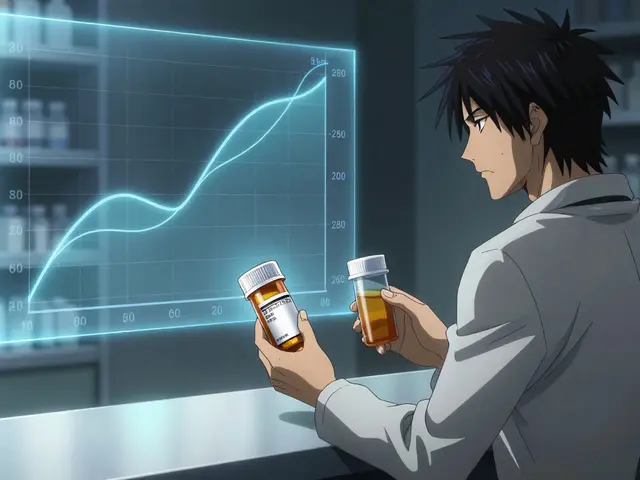
The real magic happens as more competitors enter. As the number of generic manufacturers increases, competition intensifies. A study published in JAMA Health Forum analyzed 505 drugs across eight high-income countries and found that prices fell by 32% in the first year after patent expiration in the United States. Over an eight-year period, that figure jumped to an 82% reduction. In markets with ten or more generic competitors, prices can plummet by up to 80% within three years. This non-linear pattern means that the second and third generic entrants often drive down prices faster than the first.
This mechanism works best for "small molecule" drugs-chemical compounds like aspirin, statins, or blood thinners. These are relatively easy to manufacture and replicate. Once the patent expires, multiple factories can produce identical versions quickly. The result is a rapid erosion of the brand-name company's market share and pricing power. Patients see immediate relief at the pharmacy counter, and insurance plans shift their formularies to favor these cheaper options.
| Timeframe | US Price Drop | Key Market Dynamic |
|---|---|---|
| Year 1 | 32% | First generic enters; moderate competition |
| Years 2-4 | Steepest Decline | Multiple generics enter; intense price wars |
| Year 8 | 82% | Mature generic market; minimal brand share |
If small molecule drugs follow a predictable path to affordability, biologics tell a different story. Biologics are large, complex proteins made from living cells, used to treat conditions like rheumatoid arthritis, Crohn's disease, and certain cancers. Because they are so complex, creating a generic version-called a biosimilar, which is a highly similar version of a reference biologic product-is far more difficult and expensive than copying a chemical pill.
The case of Humira (adalimumab), once the world's best-selling drug, illustrates this challenge perfectly. AbbVie, the manufacturer, built a "patent thicket" of over 130 secondary patents around the drug. These patents covered everything from the manufacturing process to specific dosing methods. Even though the primary patent expired, these secondary barriers kept competitors at bay for years. It wasn't until January 2023, nearly seven years after the initial expiry, that meaningful biosimilar competition arrived with the launch of Amgen's Amjevita. By then, AbbVie had already generated billions in revenue without significant price pressure.
Even when biosimilars do enter the market, the price drop is often slower and less dramatic than with small molecules. The "patent dance," a series of negotiations mandated by the Biologics Price Competition and Innovation Act (BPCIA), can delay biosimilar entry by two to four years. Additionally, originator companies often sign restrictive contracts with pharmacies and insurers, promising rebates if they exclude biosimilars. This creates a hidden barrier where the biosimilar might be available, but patients still receive the expensive brand-name drug because their insurance plan prefers it.

Pharmaceutical companies are acutely aware of the "patent cliff"-the sudden loss of revenue when exclusivity ends. To soften this blow, they employ lifecycle management strategies designed to extend market protection. One common tactic is "evergreening," where companies file new patents for minor modifications to an existing drug. This could be a new dosage form, a combination with another drug, or a slightly altered delivery method.
A report by I-MAK titled "Overpatented, Overpriced" highlighted that the average blockbuster drug accumulates 10 to 15 secondary patents. These collectively extend effective market exclusivity by 12 to 14 years beyond the initial patent term. For example, semaglutide products like Ozempic and Wegovy have accumulated 142 patents across three formulations. While the base compound patent may expire in 2026, these secondary patents could block generic competition until 2036.
This strategy has tangible consequences for consumers. When Eliquis (apixaban) faced patent challenges, its manufacturer used litigation and secondary patents to delay generic entry. Patients reported paying $850 a month for the brand name versus $10 for the generic once it finally became widely available. The delay meant millions of dollars in unnecessary spending for patients and insurers during the interim period. Regulatory bodies like the USPTO have begun scrutinizing these practices, but the legal framework still allows for significant extension through incremental innovations.
The impact of patent expiration is not uniform across the globe. Different countries have varying regulatory frameworks, reimbursement policies, and levels of generic market penetration. The JAMA Health Forum study revealed stark contrasts. While the US saw an 82% price drop over eight years, Switzerland experienced only an 18% decline. Other countries fell in between: Australia (64%), Germany (58%), UK (60%), France (53%), Canada (48%), and Japan (42%).
These differences stem from how governments manage drug pricing. In Europe, reference pricing systems and centralized reimbursement negotiations help ensure that generic adoption is rapid and widespread. In the US, the fragmented nature of the insurance market and the role of Pharmacy Benefit Managers (PBMs) complicate the picture. PBMs often negotiate rebates with manufacturers, which can sometimes obscure the true cost to the patient. A Kaiser Family Foundation survey found that while 68% of insured adults reported lower out-of-pocket costs with generics, 22% noted that insurance formulary changes delayed their access to these lower-cost alternatives.
The timing of generic entry also varies. In the US, the average generic entry occurs 30 months post-patent expiry, compared to 12-18 months in Europe. This lag in the US is partly due to the complexity of the FDA approval process and the prevalence of litigation between brand and generic manufacturers. The result is that American patients often wait longer for the benefits of competition than their counterparts abroad.

For patients, the bottom line is that patent expiration is your best friend when it comes to lowering medication costs. However, you cannot always rely on the calendar. If you are taking a biologic or a drug with a known history of evergreening, expect delays. Talk to your doctor about generic alternatives early. Ask if there are therapeutic equivalents available that might be cheaper, even if they aren't exact chemical copies.
Prescribers play a crucial role in this transition. Doctors like Dr. Sarah Kim, a rheumatologist in Chicago, have observed dramatic uptake of biosimilars for infliximab since 2016. However, she notes that the transition for adalimumab was slower due to restrictive contracts. Physicians can advocate for their patients by specifying "dispense as written" only when necessary and encouraging pharmacists to substitute generics automatically. In 49 US states, automatic substitution of therapeutically equivalent generics is permitted, making this a simple win-win for cost savings.
Insurance companies and employers should also review their formularies regularly. Ensuring that newly approved generics and biosimilars are placed on preferred tiers can accelerate adoption and reduce overall healthcare spending. The Congressional Budget Office projects that generic and biosimilar competition will save the US healthcare system $1.7 trillion over the next decade, but only if these savings reach patients in a timely manner.
The landscape is shifting. Regulatory agencies are becoming more aggressive in curbing abusive patent practices. The FDA approved 870 generic drugs in 2023, a 12% increase from the previous year, with a focus on clearing bottlenecks for complex generics. The European Commission's 2024 Pharmaceutical Package proposes limits on supplementary protection certificates to prevent excessive extensions. Meanwhile, the Inflation Reduction Act's Medicare drug price negotiations are creating new incentives for manufacturers to time their generic entries strategically.
Despite these positive steps, challenges remain. The rise of complex generics and biosimilars means that the gap between patent expiry and actual price competition may widen for some classes of drugs. Without further patent reform, I-MAK warns that savings could be delayed by an average of 4.2 years per drug. The goal for policymakers, healthcare providers, and patients must be to streamline the path to competition while preserving the incentives for genuine innovation.
In the end, the economic impact of patent expiration is profound. It transforms healthcare spending from a monopoly-driven model to a competitive one. While companies will always seek to protect their investments, the entry of generics remains the most powerful tool we have for making essential medicines affordable. Understanding these dynamics empowers patients to ask the right questions and helps prescribers make informed decisions that prioritize both health and financial well-being.
In the United States, drug prices typically drop by 32% in the first year after patent expiration and can fall by up to 82% over eight years. The extent of the drop depends on the number of generic competitors entering the market, with deeper declines occurring as more manufacturers join.
Prices may not drop immediately due to "patent thickets," where companies hold multiple secondary patents on minor aspects of the drug. Litigation, regulatory approval times for generics, and restrictive contracts between manufacturers and insurers can also delay the entry of cheaper alternatives.
A generic drug is an exact copy of a small-molecule brand-name drug, with identical active ingredients. A biosimilar is a highly similar version of a complex biologic drug made from living cells. Biosimilars are not identical copies but must demonstrate no clinically meaningful differences in safety, purity, and potency.
Yes, in 49 US states, pharmacists can automatically substitute a therapeutically equivalent generic for a brand-name prescription unless the doctor specifies "dispense as written." This practice helps reduce costs for patients and insurers.
Patent expiration significantly reduces healthcare spending by introducing competition. However, the magnitude varies by country. The US sees larger drops (82% over 8 years) compared to countries like Switzerland (18%) due to differences in regulatory frameworks, reimbursement policies, and generic market penetration.