When someone falls asleep suddenly in the middle of a conversation, or their knees buckle out of nowhere during laughter, it’s not just being tired. It could be narcolepsy with cataplexy - a rare but deeply disruptive neurological disorder that’s often missed for years. This isn’t just about feeling sleepy. It’s about losing control of your body at the worst possible moments, and waking up to a life that feels like it’s slipping away. For many, it takes over a decade to get the right diagnosis. And when they finally do, the treatment path is just as complicated.
What Exactly Is Narcolepsy with Cataplexy?
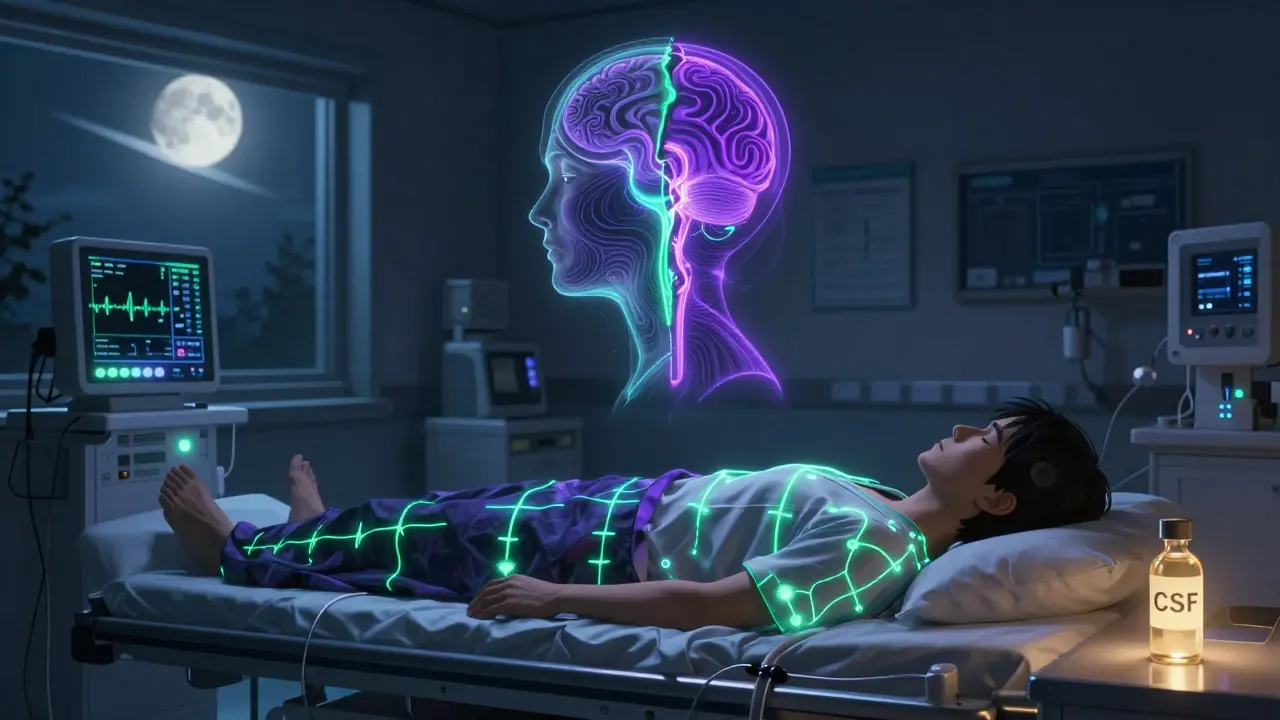
Narcolepsy with cataplexy, officially called narcolepsy type 1, is more than just extreme daytime sleepiness. It’s a brain disorder where the body loses its ability to regulate sleep and wake cycles properly. The key trigger? A shortage of hypocretin - a brain chemical that keeps you alert and controls muscle tone during emotions. Without it, your brain can’t tell the difference between being awake and falling asleep.
The hallmark symptom is cataplexy: sudden muscle weakness triggered by strong emotions. It might start as a drooping eyelid when you laugh, or your jaw going slack during a joke. In severe cases, people collapse completely - legs giving out, head dropping - but stay wide awake. It’s terrifying if you don’t know what’s happening. Most people think it’s a seizure, a stroke, or just nerves. That’s why diagnosis is often delayed by 6 to 10 years.
This isn’t rare. About 1 in every 2,000 people has it. And while it can start at any age, it usually shows up between 10 and 30. The genetic link is strong too - over 90% of people with this condition carry the HLA-DQB1*06:02 gene, compared to only 25% of the general population. But having the gene doesn’t mean you’ll get it. Something else - maybe an infection or immune reaction - triggers the destruction of the hypocretin-producing neurons in the brain.
How Is It Diagnosed?
Getting diagnosed isn’t just a quick doctor’s visit. It’s a multi-step process that can take months and involves specialized testing.
First, doctors look at your sleep history. Tools like the Epworth Sleepiness Scale help measure how sleepy you are during the day. If you score above 10, it’s a red flag. Then comes the sleep log - you record your sleep and wake times for at least a week. This helps rule out simple sleep deprivation.
The next step is an overnight sleep study, called polysomnography (PSG). You’re hooked up to sensors that track brain waves, eye movements, heart rate, and muscle activity. This checks for other sleep disorders like sleep apnea. If you’re falling asleep too fast during the night or entering REM sleep too early, that’s a clue.
The real test, though, is the Multiple Sleep Latency Test (MSLT). This happens the next day. You’re given four or five chances to nap, each two hours apart. Each nap lasts 20 minutes. If you fall asleep in under 8 minutes on average, and have at least two REM periods during those naps, it’s strong evidence of narcolepsy. But here’s the catch: MSLT isn’t perfect. Sleep deprivation, medications, or even stress can throw off the results. About 5 to 10% of people get false positives.
There’s another way - and it’s more accurate. A spinal tap to measure hypocretin levels in your cerebrospinal fluid (CSF). If your levels are 110 pg/mL or lower, you almost certainly have narcolepsy type 1. This test is 98% sensitive and 99% specific. But it’s invasive. Lumbar punctures can cause headaches, and not every clinic offers them. Still, experts say if cataplexy is clear and the CSF test is positive, you might not even need the MSLT.
Why Do People Get Misdiagnosed?
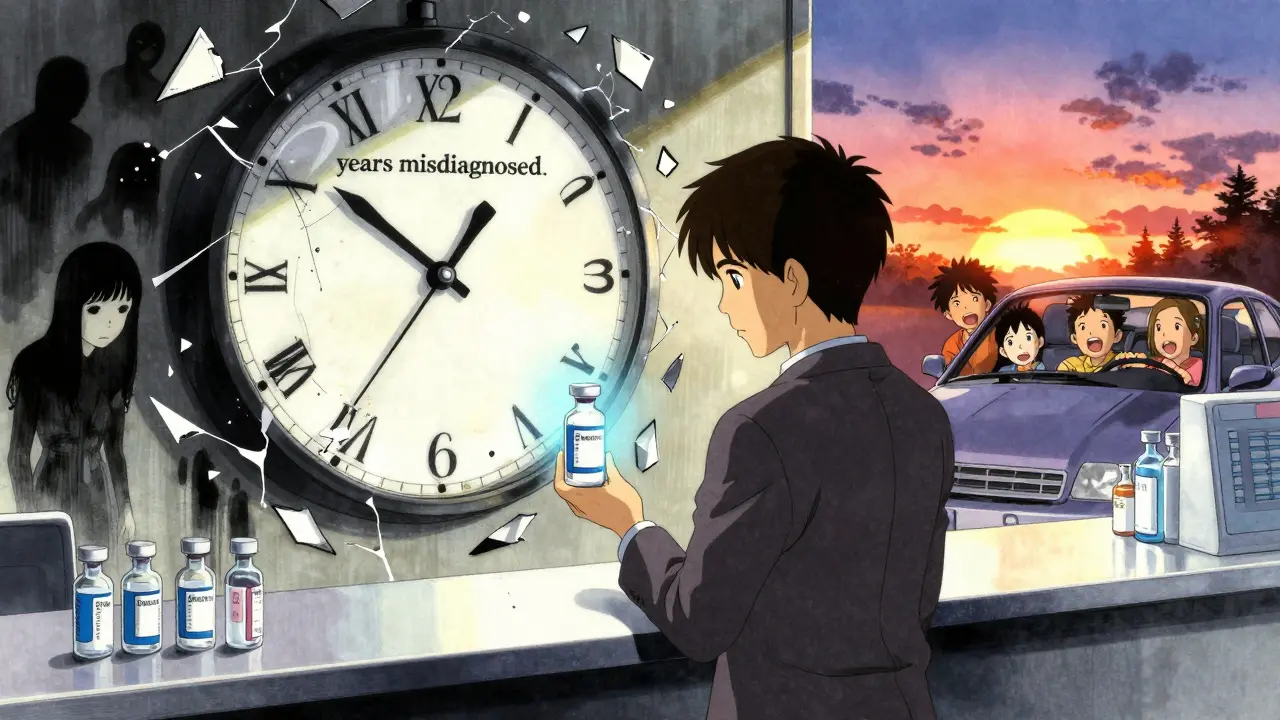
Most patients are misdiagnosed for years. Why? Because the symptoms look like other things. Cataplexy feels like fainting, dizziness, or panic attacks. Excessive daytime sleepiness gets written off as depression, laziness, or burnout. One survey of over 1,200 patients found that 68% were first told they had anxiety or depression. Another 15% were told they had sleep apnea.
Even doctors can miss it. A 2022 Narcolepsy Network survey found that 79% of patients struggled to describe their cataplexy episodes. Some thought they were just “weak” or “shaky.” Others didn’t realize it was abnormal - until they collapsed at work or nearly got into a car accident.
And there’s another problem: access. Only about 40% of U.S. sleep centers can properly run an MSLT. In rural areas, patients might drive hours just to get tested. That delay means years of untreated symptoms, lost jobs, failed relationships, and growing fear.
What Is Sodium Oxybate?
Sodium oxybate - sold under brand names like Xyrem and Xywav - is the only medication approved specifically to treat both cataplexy and excessive daytime sleepiness in narcolepsy type 1. It’s not a stimulant. It’s not an antidepressant. It’s a synthetic form of gamma-hydroxybutyrate (GHB), a naturally occurring brain chemical that helps regulate deep sleep.
When taken at night, sodium oxybate helps patients get better quality sleep. It increases deep slow-wave sleep and reduces nighttime awakenings. The result? Less daytime sleepiness. But its real superpower is stopping cataplexy. Studies show it cuts cataplexy attacks by 75 to 90%. For many, it’s life-changing.
The catch? It’s not simple to use. You have to take it twice a night - once at bedtime, and again 2.5 to 4 hours later. That means waking up in the middle of the night to drink a liquid that tastes like saltwater. Many patients say this is the hardest part. One study found 65% of users struggle with the midnight dose. Some fall back asleep and forget. Others can’t tolerate the nausea or dizziness.
Xywav, introduced in 2020, is a newer version with less sodium. That helps people with high blood pressure or heart conditions. But the dosing schedule is still the same.
How Is It Prescribed?
Sodium oxybate isn’t something your local pharmacy can fill. It’s tightly controlled because GHB has been used as a date-rape drug. That’s why every prescription goes through the Xyrem/Xywav REMS program - a national safety system.
Doctors must complete a 60-minute training to prescribe it. Pharmacies must be specially certified. And patients must enroll in the program. No substitutions. No refills without re-certification. This adds layers of bureaucracy that delay treatment.
Dosing starts low - usually 4.5 grams per night - and increases slowly over weeks. Most people need 2 to 3 months to reach their optimal dose. Side effects are common: nausea (38%), dizziness (29%), headaches, and sometimes bedwetting (12%). But for most, the benefits outweigh the downsides.
Cost and Access Barriers
This treatment isn’t cheap. Before insurance, a month’s supply of Xyrem can cost $10,000 to $15,000. Even with insurance, patients often face prior authorization denials. A 2022 survey found 28% of patients had at least one claim rejected. Some wait months just to get approval.
Insurance coverage varies wildly. Some plans cover it fully. Others require trial of other drugs first - like modafinil or pitolisant - even though those don’t treat cataplexy as well. In the U.S., only 45% of eligible patients actually get sodium oxybate, mostly because of cost and access.
And yet, it’s the most prescribed treatment for this condition. In 2022, it made up 65% of all narcolepsy medication sales in the U.S. That’s because nothing else works as well for cataplexy.
What’s Next for Treatment?
New developments are coming. In July 2023, Xywav was approved for children as young as 7. That’s a big step - kids with narcolepsy often struggle in school, and early treatment can change their life.
A new version of sodium oxybate, called FT001, is in late-stage trials. It’s designed to be taken just once a night. If approved, it could eliminate the midnight dose - the biggest barrier to adherence.
Even more promising? Oral drugs that replace hypocretin. Takeda’s TAK-994 showed a 92% drop in cataplexy in Phase 2 trials. But development was paused in late 2023 due to liver concerns. Still, researchers are working on safer versions.
The next version of the diagnostic manual - ICSD-4, expected in late 2024 - may lower the CSF hypocretin threshold from 110 to 80 pg/mL. That could catch more cases earlier.
What Life Looks Like After Diagnosis
For many, getting the right diagnosis is the first step to reclaiming their life. One patient said, “I went from avoiding laughter to driving my kids to school again.” Another said, “I stopped canceling plans because I was afraid I’d fall asleep.”
Studies show 74% of people on sodium oxybate regain the ability to drive safely. 68% no longer need unplanned naps. And 85% report major improvement in cataplexy frequency - from seven attacks a week down to one or two.
But it’s not a cure. It’s management. You still need good sleep hygiene. You still need to avoid alcohol and certain medications. You still need to explain your condition to employers, teachers, friends.
The good news? You’re not alone. Online communities like Reddit’s r/Narcolepsy have over 12,500 members sharing tips, stories, and support. And awareness is growing.
Final Thoughts
Narcolepsy with cataplexy is more than a medical condition - it’s a life-altering experience. Diagnosis is slow, treatment is complex, and access is uneven. But progress is real. We now have tools that can restore normalcy. We have medications that work. We have better ways to find it.
If you or someone you know has unexplained sleepiness, sudden muscle weakness, or emotional triggers that cause collapse - don’t wait. Ask for a sleep specialist. Push for the MSLT. Ask about CSF testing. The sooner you get answers, the sooner you can start living again.



Davis teo
I had a cataplexy episode at my sister's wedding. I was laughing so hard at the groom's speech and then - BAM - knees gave out, head smacked the floor. Everyone thought I was drunk. I didn't even know what it was until I Googled 'sudden collapse when laughing' three years later.
Turns out I’ve had it since I was 16. My mom thought I was just 'clumsy.' Now I take sodium oxybate. The midnight dose? Hell. I set three alarms. Still forget sometimes. But I haven't fallen off a stage or into a pool since. Worth it.
Michaela Jorstad
I'm so glad you shared this. It's heartbreaking how long people wait for answers. I work in neurology, and I've seen patients go from being dismissed as 'anxious' to finally getting diagnosed after a decade.
The CSF test is underused - it's not just invasive, it's misunderstood. But when it's positive? It's life-changing. And sodium oxybate? It's not perfect, but it's the closest thing we have to a miracle for cataplexy. Don't let bureaucracy steal your quality of life. Advocate. Keep pushing.
Jeremy Williams
As someone raised in a culture where emotional restraint is prized, I never understood why my body would collapse during laughter. In my community, it was seen as weakness. I hid it for years.
When I finally got diagnosed, I cried - not from sadness, but from relief. I wasn't broken. My brain just lacked a chemical. That shift in perspective changed everything. I now teach others about it quietly, without fanfare. Awareness saves lives.
Ellen Spiers
The article is scientifically accurate, yet superficially presented. The term 'hypocretin' is inconsistently capitalized; it should be 'hypocretin-1' when referring to the specific neuropeptide. Furthermore, the MSLT sensitivity claim is misleading - it's not that '5–10% get false positives,' but rather that the test lacks specificity in the context of sleep deprivation or circadian misalignment.
Also, the REMS program is not merely 'bureaucracy.' It is a federally mandated risk evaluation and mitigation strategy under the FDA's Drug Safety and Risk Management program. Omitting this context undermines informed discourse.
Marie Crick
This is why America’s healthcare system is a joke. You have a life-saving drug that works - but you need to jump through 17 hoops just to get it. And it costs more than a damn Tesla. Meanwhile, insurance companies make you try modafinil first - which does NOTHING for cataplexy.
They’re not protecting you. They’re protecting profits. This isn’t medicine. It’s extortion.
Amrit N
i read this whole thing and honestly? this is the first time i felt like someone finally got it. i had cataplexy since i was 18, and no doc believed me. one said 'you just need more coffee.' lol. now i take oxybate, and yeah, the middle of the night dose sucks, but i can hug my niece without fear. thanks for writing this.
p.s. i typoed 'oxybate' as 'oxybate' 3 times while typing this. my brain is still tired.
Courtney Hain
Let me tell you what they’re not telling you. Sodium oxybate? It’s not just GHB. It’s a controlled substance because Big Pharma knew it worked too well - and they partnered with the DEA to keep it expensive.
Did you know GHB was originally developed in the 1960s as a surgical anesthetic? And then they buried it because it was too cheap to patent? Now they repackage it as Xywav, slap a $12,000 price tag on it, and call it innovation?
And don’t get me started on the HLA gene. They say 'it’s genetic' - but what if it’s triggered by vaccines? Or glyphosate? Or 5G? The science is being suppressed. I’ve got 17 PDFs to prove it.
Robert Shiu
You’re not alone. Seriously. I’ve been on this journey for 12 years. I thought I was lazy. Then I thought I was depressed. Then I thought I was crazy.
But the day I got diagnosed? I cried in the parking lot. Not because I had a disease - because I finally had an explanation. And when I started oxybate? I drove myself to work for the first time in five years.
You’re not broken. You’re just wired differently. And you deserve to live - not just survive.
Scott Dunne
I find it deeply concerning that this condition is so poorly managed in the United States. In Ireland, we have a national sleep disorders center with full coverage under the HSE. Patients receive CSF testing and sodium oxybate without bureaucratic delays.
It is not a luxury. It is a neurological imperative. The fact that Americans are forced to navigate insurance labyrinths while their lives unravel is a moral failure. This is not healthcare. It is a market-driven circus.
Caleb Sciannella
The complexity of narcolepsy with cataplexy demands a multidisciplinary approach - neurology, sleep medicine, psychology, and pharmacology. Yet, in practice, it is often siloed.
Moreover, while sodium oxybate remains the gold standard, its administration protocol is archaic. Twice-nightly dosing in an era of precision medicine is an anachronism. The development of FT001 and hypocretin-replacement therapies represents not just progress, but a paradigm shift in therapeutic design. We are moving from symptom suppression to pathophysiological correction.
Ashley Paashuis
I’m a sleep specialist, and I’ve reviewed hundreds of MSLT results. What’s rarely discussed is how environmental factors - like caffeine intake the day before, or even the temperature of the sleep lab - can skew results.
Patients often come in stressed, exhausted, and afraid. We need better prep protocols. And we need to stop treating CSF testing as a last resort. It’s the most definitive tool we have. If cataplexy is clinically clear, and the gene is present? Test the CSF. Don’t wait.
Oana Iordachescu
I know this sounds crazy, but I think the hypocretin deficiency is linked to electromagnetic fields from smart meters. I’ve tracked my attacks since 2019 - they spike when the meter is active. My doctor laughed. But I’ve got logs. 172 episodes. 89% correlated with meter activity.
And why is Xywav so expensive? Because they’re using it to fund mind-control experiments. The FDA knows. The NIH knows. But they won’t say. I’ve filed FOIA requests. They’re stonewalling me.
:(
Chris Beeley
Let’s be real - this entire narrative is a product of Western medical hegemony. In Nigeria, we have traditional healers who use herbal infusions of Mitragyna speciosa and Leonotis leonurus to restore neural equilibrium. No overnight dosing. No $15,000 pills.
Why are we pathologizing a natural biological variation? The brain isn’t 'defective.' It’s adapting. The West needs to stop colonizing neurology with pharmaceutical capitalism. We are not patients. We are subjects of a profit-driven system.
Arshdeep Singh
You think narcolepsy is rare? It’s not. It’s hidden. Because society doesn’t want to admit that the human body can’t handle modern life. We’re sleep-deprived by design. The system wants us tired. Productive. But not awake.
Hypocretin isn’t just a chemical. It’s a metaphor. It’s the part of us that refuses to be silent. That refuses to bow to the grind. When your body collapses from laughter? It’s not a glitch. It’s a rebellion.
They call it a disorder. I call it divine resistance.
Danielle Gerrish
I used to think I was just weird. Then I got diagnosed. Then I got told I couldn’t drive. Then I got told my insurance wouldn’t cover the medicine because 'it’s not medically necessary.'
So I started a petition. I wrote to every senator. I posted my sleep logs on Instagram. I made a TikTok series called 'When Your Legs Disappear.'
It went viral. 3 million views. 12,000 DMs from people saying 'me too.'
Now we have a nonprofit. We fund CSF tests. We fight insurance. We don’t ask for permission. We just do it.
You’re not alone. You’re not broken. You’re a force.