

You might have a prescription for a brand-name medication that costs hundreds of dollars a month. You know generics exist and are cheaper, but sometimes the pharmacy says the generic isn't available yet. Then, they offer you an "authorized generic" at a lower price than the brand, but higher than a standard generic. It’s confusing. Is it safe? Where does it come from? And how can you verify if one exists for your specific medication?
Finding this information is harder than it should be because authorized generics don’t show up in the usual places. They aren’t listed in the famous FDA Orange Book where most generic drugs live. Instead, they sit on a separate, less-known list maintained by the U.S. Food and Drug Administration (FDA). This guide will walk you through exactly where to find that list, how to read it, and why there is a difference between these products and the generics you usually see.
To understand where to look, you first need to know what you are looking for. An authorized generic is the exact same drug as the brand-name version, manufactured by the same company, but sold under a different label without the brand name.
Think of it like this: A major pharmaceutical company makes a popular heart medication called "BrandX." When the patent for BrandX expires, other companies can make their own versions (traditional generics). But before those competitors launch, the original maker of BrandX might decide to sell the identical pill under a plain white box labeled just with the chemical name, say "Atorvastatin," instead of "BrandX." That is an authorized generic.
The key difference lies in the paperwork. Traditional generics get approved through an Abbreviated New Drug Application (ANDA) and must prove they are bioequivalent to the brand. Authorized generics are marketed under the brand manufacturer's original New Drug Application (NDA). Because they are literally the same product coming from the same factory line, they are considered therapeutically equivalent by definition. However, they do not go through the ANDA process, which means they are excluded from the FDA’s primary database for generic drugs, known as the Orange Book.
If you want to check if an authorized generic exists for a specific drug, you cannot rely on Google searches or general pharmacy websites. You need the source data. The FDA maintains a specific document titled the "Listing of Authorized Generic Drugs."
Here is how to access it:
fda.gov/drugs/abbreviated-new-drug-application-anda/fda-list-authorized-generic-drugs.As of the latest updates in late 2025, this list is published as a static PDF document. It is updated quarterly, as mandated by the Medicare Prescription Drug, Improvement, and Modernization Act of 2003. The most recent version available often dates back several months, so keep in mind that the data reflects reports submitted annually by manufacturers, not real-time market changes.
Once you download the PDF, you might feel overwhelmed. It looks like a dense spreadsheet. Don’t worry; it follows a consistent structure. Each entry contains four critical pieces of information:
For example, if you search for "ARTHROTEC," you might find an entry showing it was entered into the market on November 1, 2012, by Pfizer Inc. This tells you that Pfizer sells a non-branded version of Arthrotec. However, there is a catch with the date column. The FDA explicitly states that this date reflects the annual reporting period, not necessarily the exact day the drug hit the shelves. Furthermore, the list does not track whether the drug is still being sold today. A drug might appear on the list from 2015, but the company may have stopped producing the authorized generic version last year.
| Feature | FDA Authorized Generics List | FDA Orange Book | Drugs@FDA Database |
|---|---|---|---|
| Tracks Authorized Generics? | Yes (Primary Source) | No | Indirectly (via NDA details) |
| Format | Static PDF (Updated Quarterly) | Searchable Web Database | Searchable Web Database |
| Shows Current Availability? | No (Historical Reporting Only) | Yes (Approval Status) | Yes (Approval Status) |
| Best Used For | Identifying potential AG existence | Checking therapeutic equivalence of traditional generics | General drug approval history |
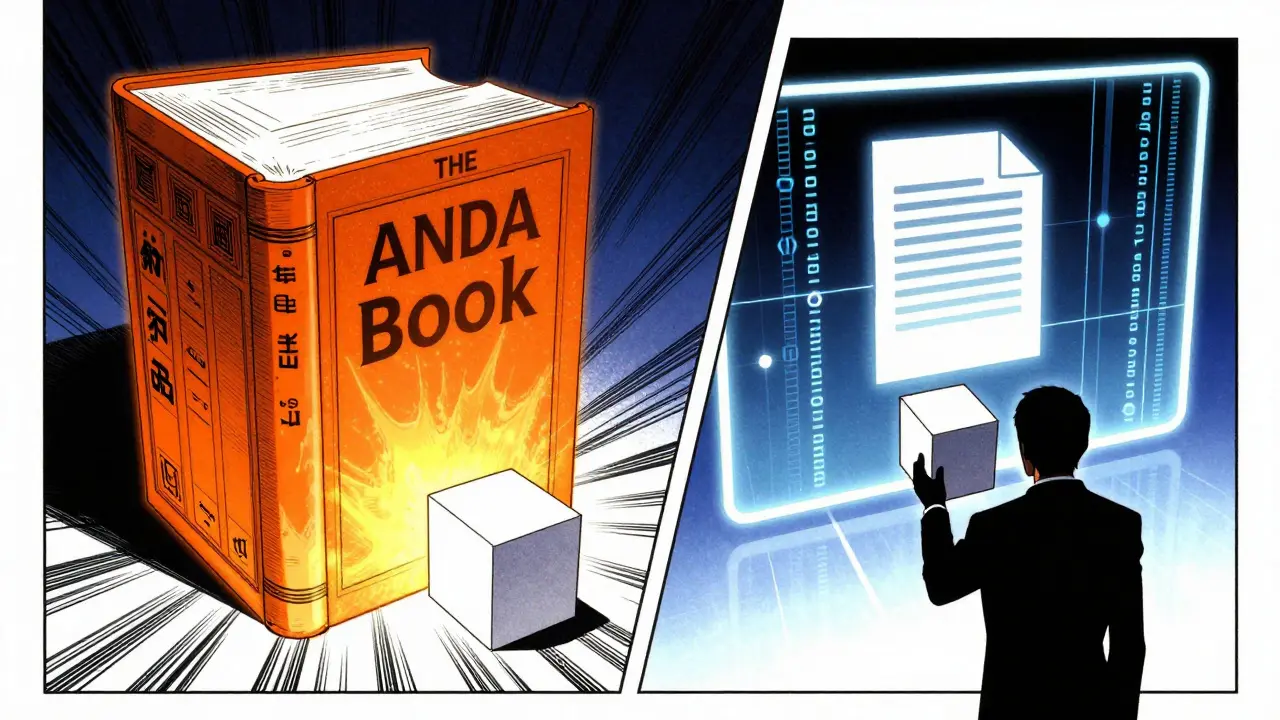
This is the most common mistake people make. The FDA Orange Book (Approved Drug Products With Therapeutic Equivalence Evaluations) is the gold standard for checking generic availability. If you type a drug name into the Orange Book, you see a list of generic manufacturers and their therapeutic equivalence codes (like AB, AA, etc.).
However, authorized generics are invisible here. Because they are sold under the brand manufacturer’s NDA, they are legally part of the brand product’s record, not a separate generic application. The Orange Book only lists drugs approved via ANDAs. So, if you are looking for an authorized generic of a popular statin or painkiller, the Orange Book will tell you nothing about it. You must cross-reference the Orange Book (to see traditional generics) with the FDA’s separate Authorized Generics List (to see if the brand maker is also selling a plain-label version).
While the FDA list is the only authoritative public source for identifying which drugs have authorized generic versions, it has significant blind spots for everyday users.
1. No Real-Time Availability
The FDA admits it does not know if an authorized generic is still on the market. The list is built from annual reports submitted by companies. If a company stops selling the authorized generic version in January but doesn’t update their report until next year, the drug remains on the list. Pharmacists and researchers often find entries that are technically correct historically but practically useless because the product is discontinued.
2. Lack of Pricing Data
The list tells you *that* an authorized generic exists, but not *how much* it costs. Prices fluctuate based on supply, demand, and competition from traditional generics. To get pricing, you would need to check with wholesalers or use commercial databases like IQVIA, which track sales perspectives.
3. Searchability Issues
Currently, the list is a PDF. You cannot filter by therapeutic class, expiration date, or manufacturer easily. You have to manually scan or use the "Find" function in your PDF reader. The FDA has announced plans to transition this to a dynamic, searchable database format by mid-2026, which should improve usability significantly.
If you are a patient trying to save money, or a pharmacist looking for alternatives, here is a workflow that works better than relying solely on the FDA PDF:
Industry experts, including analysts from the Federal Trade Commission (FTC), note that authorized generics are often used strategically by brand companies to protect market share during the 180-day exclusivity period granted to the first generic applicant. Understanding this context helps explain why these products exist-they are a middle ground between high-cost brands and low-cost generics.
The landscape for finding this information is shifting. In 2024, stakeholders at an FDA public meeting requested better search functionality and real-time updates. The FDA’s Center for Drug Evaluation and Research (CDER) has acknowledged these needs. By Q2 2026, we expect the static PDF to be replaced by an interactive web tool. This will likely integrate with the Drug Shortage Portal, providing clearer visibility on whether an authorized generic is actually available or if it is merely a historical artifact.
Until then, treat the FDA’s PDF list as a starting point for research, not a definitive inventory. Combine it with professional pharmacy resources to ensure you are getting accurate, actionable information for your health decisions.
Yes. An authorized generic is manufactured by the same company using the same facility and processes as the brand-name drug. It contains the same active ingredient, strength, dosage form, and route of administration. The only differences are the packaging and the label, which omits the brand name.
The Orange Book tracks drugs approved through Abbreviated New Drug Applications (ANDAs). Authorized generics are marketed under the brand manufacturer's original New Drug Application (NDA). Since they do not undergo the ANDA approval process, they are excluded from the Orange Book and tracked separately in the FDA's Listing of Authorized Generic Drugs.
The FDA is required by law to update the list quarterly. However, the data within the list comes from annual reports submitted by manufacturers, so it may lag behind real-time market conditions. The most recent updates reflect data submitted in the previous reporting periods.
No. The FDA list provides information on the existence, manufacturer, and market entry date of authorized generics, but it does not include pricing information. Prices vary by pharmacy, region, and insurance coverage. You must consult your pharmacist or wholesaler for current costs.
Typically, yes. Authorized generics are priced lower than the brand-name version to compete with traditional generics. However, they are usually more expensive than traditional generics. The savings depend on the specific drug, the level of competition, and your insurance plan's formulary.
No. The FDA explicitly states that the list does not indicate whether an authorized generic is still being marketed. It serves as a historical record of drugs that have been launched as authorized generics. To determine current availability, you should check with your pharmacist or use commercial drug distribution databases.



Earl Oleary
You are completely missing the point of how the pharmaceutical industry operates. The FDA list is a relic, a paper tiger that serves no real purpose for the average consumer who is just trying to survive on a fixed income. The fact that this data is locked in a static PDF updated quarterly is not an oversight; it is a feature designed to obscure the true availability of these drugs. Big Pharma wants you confused so you pay the brand name price. They know most people won't download a PDF and cross-reference NDC codes. It is a deliberate barrier to entry for informed patients. You need to stop trusting the 'official' channels and start looking at wholesaler inventories directly if you want the truth about what is actually on the shelves right now.
Crystal Tadlock
They are lying to us all!! The government knows exactly which drugs are available but they hide it to keep us sick and poor!!! I tried to get my generic last week and the pharmacist said it was out of stock but I saw the box in the back room!!! It is a conspiracy to control our bodies!!!
Sean Allwurden
I appreciate the detailed breakdown here. As someone who works in supply chain logistics for healthcare providers, I can confirm that the disconnect between the FDA's static reporting and real-time inventory is a massive pain point. We often see authorized generics listed as active in the database when the manufacturer has quietly ceased production months ago due to raw material shortages or strategic pivots. The key takeaway for stakeholders is to treat the FDA PDF as a historical ledger rather than a live feed. Leveraging tools like the NDC Directory alongside the Orange Book provides a more robust triangulation method for verifying therapeutic equivalence and current market presence. It’s a tedious workflow, but necessary until CDER rolls out that promised interactive tool in 2026.
Laura Odom
oh wow. another boring guide about pills. i dont trust any of this stuff anyway. the whole idea of 'authorized' generics sounds like a scam to me. why would they sell the same thing for less? its probably fake. or poisoned. idk. i just buy the brand name because it feels safer even though it costs my soul.
Katie Caruthers
It makes me so angry that we have to do this legwork ourselves. Pharmacists should be legally required to tell us if an authorized generic is available before charging us full price. It is unethical to let patients pay hundreds of dollars when a cheaper identical option exists from the same company. I feel like I am being robbed every time I go to the pharmacy. Why is the system so broken??
Najmunisa Govender
I really wish this information was easier to find! It is so stressful trying to manage medication costs while also dealing with health issues. Thank you for explaining the difference between the Orange Book and the Authorized Generic list. It helps to know that the drug is made by the same company. I will try asking my pharmacist next time I pick up my prescription. Hopefully, they can help me check the wholesaler inventory like you suggested!
Vineet Hawelia
This is a well-structured analysis of the regulatory landscape. In India, we often face similar challenges with drug pricing and availability transparency. The distinction between ANDA and NDA pathways is crucial for understanding why certain generics do not appear in standard databases. It is interesting to note that the FDA plans to digitize this list by 2026. Until then, manual verification remains the only reliable method for ensuring accurate procurement decisions.
Jairam Prasad
Ah, the eternal dance between profit and public health. The FDA list is not a bug; it is a feature of a system designed to maximize shareholder value over patient welfare. The delay in updates ensures that consumers remain in a state of uncertainty, paying premium prices out of fear or ignorance. Truly fascinating how bureaucracy serves capital.
Tad Cronn
Let me tell you something about your privacy. When you ask your pharmacist to check these lists, they are digging into your medical history and financial status. Do you really want them knowing exactly what you can afford? The FDA doesn't care about your wallet. They care about their data. Stop giving away your personal information to every clerk in a white coat. Keep your business to yourself.
Megan Crossland
the system is rigged. big pharma wins. we lose. simple as that.