Ever looked at your prescription bottle and wondered why there are two names on it? One big, bold, and familiar - like Lipitor. The other smaller, harder to pronounce - like atorvastatin. You’re not alone. Millions of people in the UK and the US see this every time they pick up medication. And most don’t know what it really means.
What’s the difference between generic and brand names?
The big name on your pill bottle - say,
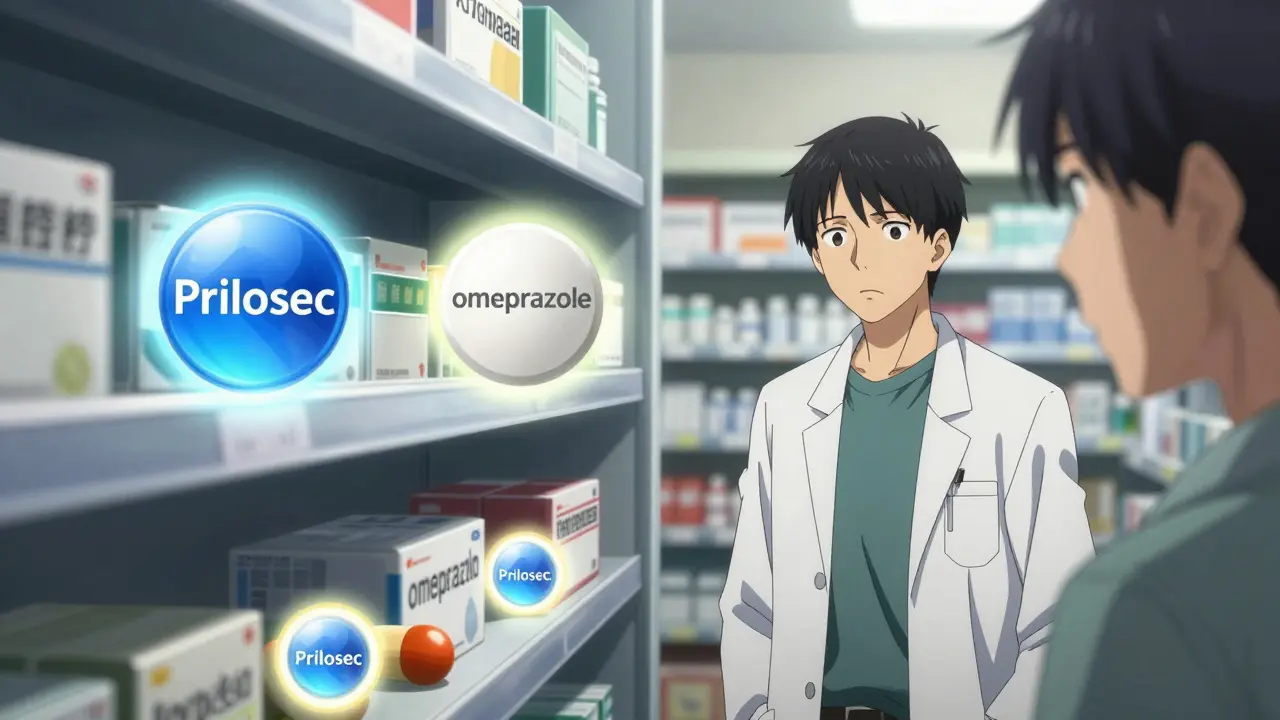
Prilosec - is the brand name. It’s the one the drug company made up, trademarked, and spent millions marketing. The smaller name underneath -
omeprazole - is the generic name. That’s the actual active ingredient. Think of it like Coca-Cola versus carbonated sugar water. Same effect. Different packaging, different price.
All generic drugs contain the exact same active ingredient as the brand version. They work the same way in your body. They’re taken the same way. Same dose. Same strength. Same route - whether it’s a pill, capsule, or liquid. The U.S. Food and Drug Administration (FDA) requires this. So does the UK’s MHRA. No exceptions.
But here’s where people get confused: generics often look different. They might be a different color, shape, or size. That’s not because they’re weaker. It’s because trademark laws forbid them from looking identical to the brand version. So a blue oval pill becomes a white round one. The active ingredient? Still omeprazole. Still works.
Why are generics so much cheaper?
Brand-name drugs cost a fortune because the company had to pay for years of research, clinical trials, and marketing. The average cost to bring one new drug to market? Around $2.6 billion. That’s not a typo. That’s why Lipitor used to cost $300 a month.
Generic manufacturers don’t have to repeat those expensive trials. They just need to prove their version works the same way - bioequivalence. That means the amount of drug in your bloodstream is within 80-125% of the brand version. That’s the FDA’s acceptable range. It’s not a guess. It’s science. And it’s why generics cost 80-85% less. Atorvastatin? Around $4 a month.
Even more surprising: about half of all generic drugs are actually made by the same companies that make the brand versions. Pfizer, AstraZeneca, Merck - they all make generics too. Just under different names. So when you take a generic, you might be getting the exact same pill, just without the fancy label.
What’s on the prescription label?
When you get your prescription filled, the pharmacist is required to list both names on the label. The brand name is usually bigger. The generic name is smaller, but still clearly printed. In fact, 92% of U.S. and UK prescription labels follow this format. You can always ask your pharmacist to point it out.
If your doctor wrote “dispense as written” or “do not substitute,” then the pharmacy must give you the brand name. But unless that’s written, they’ll give you the generic - because it’s cheaper, and your insurance plan likely requires it. In 28 U.S. states, pharmacists can automatically switch to generics unless the doctor says no. In the UK, the NHS encourages generics by default.
You don’t need to be a pharmacist to read your label. Just look for two names. The big one is the brand. The small one is what’s actually in the pill. Write it down. Keep it in your phone. Next time you refill, you’ll know exactly what you’re taking.
Are generics really just as good?
Yes. The FDA, NHS, WHO, and every major medical association agree: generics are just as safe and effective as brand-name drugs. Over 90% of prescriptions filled in the U.S. are for generics. That’s not because people are desperate. It’s because they work.
Studies show that 78% of patients are satisfied with generics - once they understand they’re the same. But 32% are nervous at first. Why? Because of how they look. A 2022 CVS Health survey found that 24% of patients thought a different-looking pill meant it was weaker. That’s not true. But it’s a real problem.
Some people report side effects after switching. A Reddit thread from September 2023 with over 1,200 comments had people saying things like, “I feel different on the generic.” But when you dig into the science, it’s rarely the active ingredient. It’s the fillers - the lactose, dyes, or coatings. Those aren’t the medicine. They’re just what holds the pill together. For most people, it doesn’t matter. But for a small group with sensitivities - say, to a specific dye - it can cause discomfort. That’s why pharmacists are trained to ask: “Have you had any issues with this medication before?”
When should you stick with the brand?
There’s one group where doctors sometimes prefer the brand: drugs with a narrow therapeutic index (NTI). These are medications where even tiny changes in blood levels can cause big problems. Think warfarin (blood thinner), lithium (for bipolar disorder), or phenytoin (for seizures). The FDA says generics are still approved for these - but some doctors, especially for new patients, will start with the brand to get the dose right.
Even then, once the dose is stable, many patients switch to generic without issue. The key is communication. Talk to your doctor. Talk to your pharmacist. Don’t assume the generic won’t work. Ask if it’s safe for your specific case.

What’s changing in 2026?
The world of generics is evolving. In the U.S., the Inflation Reduction Act of 2022 caps Medicare Part D out-of-pocket costs at $2,000 a year starting in 2025. That’s pushing more seniors toward generics. The FDA’s new GDUFA III plan aims to cut approval times for generics by 20% by 2027 - meaning more options, faster.
But there’s a shadow. Over 80% of the active ingredients in pills - whether brand or generic - come from just two countries: China and India. Supply chain issues during the pandemic caused shortages of blood pressure meds, antibiotics, and even birth control pills. That’s why some pharmacists now keep a backup brand version on hand - just in case.
And biologics - complex drugs made from living cells, like insulin or rheumatoid arthritis treatments - are now going generic too. These are called biosimilars. They’re not exact copies like small-molecule generics. They’re close. And they’re 15-30% cheaper, not 80%. But they’re still a win for patients.
What should you do?
1.
Read your label. Know both names. Write them down.
2.
Ask your pharmacist. “Is this generic? What’s the active ingredient?” They’re paid to answer this.
3.
Don’t panic if it looks different. Same ingredient. Same effect.
4.
Report real side effects. If you feel worse after switching, tell your doctor. It might be the filler, not the drug.
5.
Use cost-saving tools. Apps like GoodRx show price differences. Sometimes the brand is cheaper than the generic at your local pharmacy - because of insurance quirks.
The bottom line? Generic drugs aren’t second-rate. They’re the backbone of modern medicine. They save patients billions. They keep treatments affordable. And they’re just as effective as the brand name - when used correctly.
You don’t need to be a scientist to understand your prescription. You just need to know what to look for.



Nilesh Khedekar
So let me get this straight-you’re telling me I’ve been overpaying for blue pills my whole life, and the white ones are literally the same thing?!!! I mean, come ON. I’ve been convinced for years that the fancy ones had ‘better science’-turns out it’s just marketing magic. My pharmacist laughed when I asked why they switched me. Said, ‘Sir, your insulin is still insulin.’ I felt like an idiot. And proud. And broke. And smarter.
Gloria Montero Puertas
How is it even legal to allow such a thing? The active ingredient may be identical, but the bioavailability variance-even within the FDA’s 80–125% range-is a statistical minefield. I’ve seen patients on warfarin destabilize after switching. And don’t get me started on the fillers-phthalates, talc, gluten derivatives in pills meant for the elderly. This isn’t ‘equivalence’-it’s corporate convenience dressed up as public health.
Dan Mack
China and India make 80% of our pills? And you think that’s safe? The FDA doesn’t even inspect half those factories. Remember the heparin scandal? Or the lead in children’s Tylenol? This is all a controlled demolition. They want you dependent on cheap meds so you don’t question why your cancer drug costs $12,000 a month. The real drug? It’s in a Swiss lab. The pill you take? It’s a shell. A puppet. A lie.
Sarah Mailloux
I used to be scared of generics too-until my mom switched to generic metformin and her blood sugar stabilized. She said the pill looked weird but didn’t feel any different. I started asking my pharmacist every time. Turns out, most of the time, the brand and generic come from the same warehouse. Same batch, different label. I keep a little note in my phone now: ‘Same stuff. Different price. Ask.’ It’s saved me over $1,200 a year. And no, I’m not a genius. I just stopped trusting ads.
Jami Reynolds
It is imperative to recognize that the regulatory frameworks governing bioequivalence are not infallible. The 80–125% confidence interval, while statistically acceptable, permits a 45% variance in systemic exposure. For patients with comorbidities, polypharmacy, or renal impairment, such deviations may precipitate adverse events. The FDA’s approval process prioritizes throughput over individualized pharmacokinetic analysis. This is not a triumph of accessibility-it is a systemic compromise.
Amy Ehinger
My aunt takes a generic version of her thyroid med and swears she feels ‘off’-like her brain is wrapped in cotton. We thought it was just her being dramatic. Then we found out the generic had a different dye-FD&C Yellow No. 6-and she’s allergic to it. Not the medicine, just the coating. She switched back to brand and felt like herself again. So yeah, the active ingredient is the same-but the pill? It’s got a personality. And sometimes, that personality doesn’t like you. Just sayin’.
RUTH DE OLIVEIRA ALVES
It is a matter of considerable public health importance that patients be empowered with accurate, unambiguous information regarding pharmaceutical composition. The dual-naming convention on prescription labels is not merely a regulatory formality-it is an educational opportunity. Pharmacists, as accessible healthcare professionals, bear a professional obligation to elucidate the distinction between proprietary and nonproprietary nomenclature. Failure to do so constitutes a lapse in patient-centered care.
Crystel Ann
I used to panic every time my pill changed color. I’d Google it for hours, convinced I’d been given the wrong medicine. Then I started asking my pharmacist-just one simple question: ‘Is this the same as last time?’ And they’d say yes, and explain what changed. No judgment. No rush. I wish I’d done it sooner. It’s not about being smart. It’s about being brave enough to ask.
Diane Hendriks
Let’s be clear: America’s reliance on foreign-made generics is a national security crisis. We outsource our medicine to nations with no accountability, no rule of law, no respect for intellectual property or human health. Our soldiers, our seniors, our children are taking pills made in factories where inspectors are bribed. This isn’t cost-saving-it’s surrender. We need to bring pharmaceutical production back to the U.S. or risk becoming a nation of chemically dependent subjects.
ellen adamina
What about the people who can’t afford even the generic? Or those whose insurance still won’t cover it? The system says generics are cheaper, but what if your pharmacy doesn’t stock them? Or your doctor won’t prescribe them? It’s not just about knowing the names-it’s about whether you can actually get the pill at all.