

When you pick up a new prescription, how do you know what it’s really for-and what might go wrong? You might Google the drug name, but then you’re flooded with ads, technical jargon, and conflicting advice. That’s where MedlinePlus Drug Information comes in. It’s not a marketing site. It’s not a forum. It’s a free, government-backed resource that cuts through the noise and gives you clear, accurate, plain-language safety summaries for over 1,500 prescription drugs, over-the-counter medicines, vaccines, and herbal supplements.
Every drug page on MedlinePlus follows the same simple structure. No guessing. No scrolling through ads. You get:
Each page also shows the exact date it was last updated. That’s not just a footnote-it means you’re getting current info. If a new warning came out last month, you’ll see it here. No outdated advice.
WebMD, Drugs.com, and other popular health sites look similar-but they’re not the same. Many of them run ads. Some get paid to feature certain drugs. Others overload you with technical details about how the drug works in your liver or kidneys. You don’t need that when you’re trying to figure out if that weird tingling in your fingers is normal.
MedlinePlus doesn’t do any of that. It’s run by the National Library of Medicine, part of the National Institutes of Health. That means no ads. No sponsorships. No corporate influence. Every piece of information comes from trusted sources like the American Society of Health-System Pharmacists and FDA-approved labeling. It’s the same info doctors and pharmacists use-but stripped down to what matters to you.
It also doesn’t try to be everything. No pill identifier. No drug interaction checker. No chatbot. That’s intentional. It’s not meant for clinicians. It’s meant for people who take medicine every day and want to understand it better.
You don’t need to be a computer expert to use MedlinePlus. Go to medlineplus.gov. Click on “Drugs and Supplements.” That’s it. You can search by brand name (like “Lipitor”) or generic name (like “atorvastatin”). If you spell it wrong, it will suggest the right spelling. You can browse alphabetically. You can even search in Spanish-almost all drug pages are available in both languages.
Each page has a light blue box at the top with clickable links to jump straight to side effects, storage, or overdose info. No scrolling through pages of text. If you want to print it, email it, or share it with a family member, there’s a button for that too.
And it works on your phone. No app needed. Just open your browser. The page loads fast. Even on slow connections. That’s because it’s built to be simple and reliable-not flashy.
In 2021, over 418 million people visited MedlinePlus. That’s not a typo. Eight hundred and eighty-eight million pages were viewed. People are using it. And they’re not just patients. Nurses, pharmacists, caregivers, and even medical students use it to find plain-language materials to hand out to patients.
Why? Because it’s trustworthy. If you’re helping an elderly parent manage five different medications, you don’t want to guess. You want to know what the real risks are. If you’re a teenager on a new acne treatment and your skin is breaking out worse, you want to know if that’s normal or if you need to call your doctor. MedlinePlus gives you the facts without the fear.
It’s especially helpful for the 80 million U.S. adults with limited health literacy-people who struggle to understand medical terms, dosage instructions, or warning labels. MedlinePlus doesn’t assume you know what “hypertension” means. It says “high blood pressure.”
MedlinePlus isn’t a replacement for your doctor or pharmacist. It won’t tell you if a drug is right for you. It won’t answer questions about your specific health history. If you’re pregnant, have liver disease, or are taking ten other pills, you still need to talk to your provider.
It also doesn’t cover every single drug on the market. There are over 80,000 medications in the U.S.-MedlinePlus covers the most common ones. If you’re looking for a rare specialty drug, you might need to go to a more technical database. But for the drugs you’re likely to be prescribed-antibiotics, blood pressure pills, pain relievers, antidepressants-MedlinePlus has you covered.

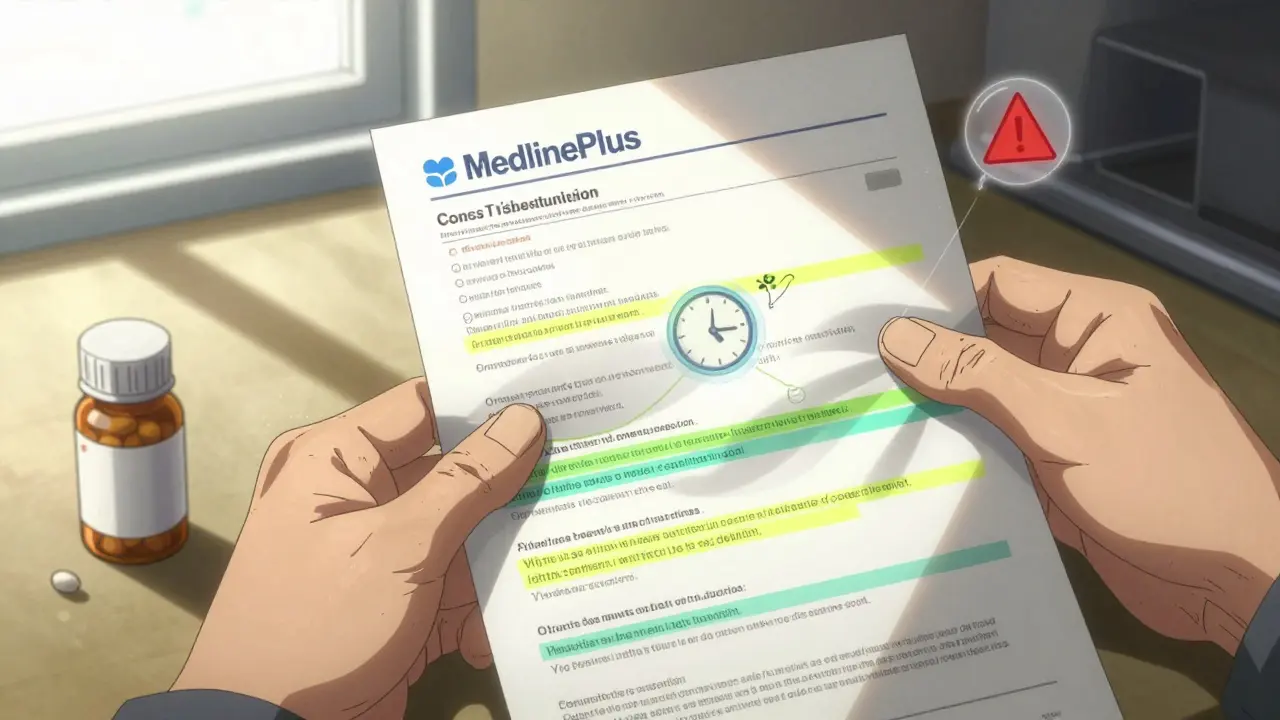
Think of MedlinePlus as your personal medication safety checklist. Before you start a new drug, look it up. Print the page. Keep it with your pill bottle. Show it to your pharmacist when you pick it up. Bring it to your next appointment. Ask: “Does this match what I read?”
Some hospitals and clinics now use a tool called MedlinePlus Connect. That means when your doctor sends you home with a new prescription, your patient portal might link directly to the MedlinePlus page for that drug. No extra search needed. Just click. It’s becoming a standard part of how healthcare systems support patients after they leave the office.
You can even sign up for email updates on specific conditions-like diabetes or heart disease-and get new safety info automatically. That’s useful if you’re on long-term meds and want to stay informed without hunting for updates.
MedlinePlus Drug Information isn’t flashy. It doesn’t have videos or quizzes or influencer endorsements. But it’s one of the most reliable health tools you’ll ever use. It was built by scientists, reviewed by pharmacists, and designed for real people-not algorithms. In a world where misinformation spreads faster than medicine, it’s a quiet, steady anchor.
If you take any kind of medication-prescription, over-the-counter, or supplement-bookmark it. Print a page. Share it. Use it. It’s free. It’s trustworthy. And it’s there when you need it most.
Yes, MedlinePlus Drug Information is completely free. It’s funded by the U.S. government through the National Institutes of Health, so there are no fees, subscriptions, or hidden costs. You don’t need to create an account or give any personal information to access it.
Yes. Every drug summary is based on FDA-approved labeling and reviewed by experts from the American Society of Health-System Pharmacists. MedlinePlus only links to sources that meet strict credibility standards. No ads, no sponsored content, no corporate influence. It’s one of the most trusted consumer health sites in the U.S.
Yes. Almost all drug information pages are available in Spanish. You can switch languages with a single click at the top of the page. The site also offers links to over 13,000 Spanish-language health resources, making it one of the most comprehensive bilingual health information sources in the country.
No, MedlinePlus doesn’t have a drug interaction checker. It lists possible interactions in the “Precautions” section of each drug page, but it won’t analyze your personal list of medications. For that, you should talk to your pharmacist or use a tool provided by your pharmacy or health system.
Absolutely. Many families use MedlinePlus to help older adults understand their medications. The clear language, simple layout, and printable pages make it ideal for caregivers. You can print the drug summary, highlight key points, and keep it with the pill bottle. It’s a simple way to reduce confusion and prevent mistakes.
Each drug page shows the exact date it was last revised-usually within a few months of new safety data being released. The National Library of Medicine updates content regularly based on FDA alerts, clinical guidelines, and expert reviews. If a drug gets a new black box warning, you’ll see it reflected on MedlinePlus quickly.
Yes. MedlinePlus includes safety summaries for hundreds of dietary supplements and herbal products like echinacea, ginkgo biloba, fish oil, and vitamin D. It tells you what they’re used for, possible side effects, and interactions with prescription drugs-important because many people don’t realize supplements can affect their medications.
If you’re taking a new medication, go to medlineplus.gov/drugs/ right now. Search for the drug. Read the side effects. Print it. Keep it with your pill bottle. Share it with a family member who helps you manage your care.
If you’re a caregiver, teacher, or community health worker, bookmark it and share it with others. It’s one of the few health tools that actually works for everyone-no matter their education level, income, or tech skills.
MedlinePlus doesn’t solve every problem. But for understanding what’s in your medicine and how to use it safely, it’s the best place to start-and often, the only place you need to go.

kenneth pillet
Just used MedlinePlus for my new blood pressure med. No ads, no fluff. Exactly what I needed. Saved it to my phone.
Simple. Clean. Works.
Jodi Harding
This is the only health site I trust. The rest are just ad farms with fake empathy.
Danny Gray
Funny how the government 'doesn't have a stake' in this. But it's still part of the NIH, which takes billions from pharma lobbying. You think they'd really risk their funding by being too honest?
Don't be fooled. It's not neutrality-it's calculated restraint.
Tyler Myers
Let me guess-this is the same 'trusted' site that didn't warn you about the 2019 FDA backdoor deal with Big Pharma to bury the truth about statin-induced diabetes?
They update the page but never the narrative. You're being managed, not informed.
And don't get me started on the Spanish version-it's just a PR prop for the census.
Zoe Brooks
I printed out the page for my mom’s diabetes meds and left it on her fridge. She actually read it. No joke.
She’s 78 and doesn’t use tech, but she understood it. That’s magic. 🙏
Kristin Dailey
America still has one good thing left. Don't let the liberals ruin it.
Wendy Claughton
I just love how this site doesn't try to be flashy... it just... works. Like a warm blanket for your health anxiety.
And the fact that it's free?
And bilingual?
And updated in real-time?
It's like someone cared.
And that... that means everything.
Thank you, NIH.
From the bottom of my heart.
❤️
Stacey Marsengill
I used to trust this site until I realized they never mention the 2022 whistleblower report about the NIH quietly removing side effects tied to corporate donors.
It's not that the info is clean-it's that the omissions are surgical.
You think you're safe? You're just being selectively fed.
And now you're proud of it.
Aysha Siera
This is all propaganda. The real drug info is hidden in the CDC's encrypted databases. MedlinePlus is just the candy coating. They want you to think you're informed so you won't ask the real questions.
rachel bellet
The structural integrity of MedlinePlus is commendable from a pharmacoeconomic standpoint, yet its epistemological framework remains tethered to FDA labeling paradigms that are inherently reactive rather than proactive. The absence of pharmacogenomic data, drug metabolism kinetics, and real-world adverse event surveillance via FAERS integration renders it clinically inadequate for polypharmacy patients. It's a patient-facing brochure, not a clinical decision support tool.