When you’re planning a trip abroad, you think about passports, visas, weather, and hotels. But what about your medicine? If you take daily pills for blood pressure, ADHD, anxiety, or chronic pain, skipping this step could land you in jail, get your meds confiscated, or leave you sick in a foreign country with no way to refill. Getting enough medication before international travel isn’t just smart-it’s essential. And it’s far more complicated than most people realize.
Why Your U.S. Prescription Might Be Illegal Abroad
You might think if it’s legal in the U.S., it’s fine anywhere. That’s dangerously wrong. Countries like Japan, Thailand, and the UAE have strict bans on common medications you probably take. Alprazolam (Xanax), oxycodone, zolpidem (Ambien), and even pseudoephedrine (in cold pills) are controlled substances-or outright banned-in dozens of countries. In Japan, over 1,400 medications you can buy at CVS are illegal. In the UAE, carrying codeine without a special permit can lead to a five-year prison sentence. Thailand has detained travelers for 72 hours just for having a few pills of zolpidem without a notarized doctor’s letter.
The U.S. Department of State reports that 12-15% of international travelers face medication-related problems. That’s not rare. It’s predictable. And it’s avoidable.
What Medications Are Most Likely to Cause Trouble?
Not all meds are equal when it comes to border rules. The CDC and International Narcotics Control Board (INCB) flag these categories as high-risk:
- Narcotics: Hydrocodone, oxycodone, codeine (even in cough syrup)
- Sedatives and anti-anxiety drugs: Alprazolam (Xanax), diazepam (Valium), clonazepam (Klonopin)
- Sleep aids: Zolpidem (Ambien), eszopiclone (Lunesta)
- ADHD stimulants: Adderall, Vyvanse, methylphenidate (Ritalin)
- Decongestants: Pseudoephedrine (Sudafed)-banned in Japan, Australia, and parts of Europe
Even if your medication isn’t banned, the dosage form might be. A 500mg tablet in the U.S. might be sold as two 250mg pills overseas. If you don’t know the generic name, you won’t be able to explain what you’re carrying.
How Much Should You Pack?
The U.S. Customs and Border Protection (CBP) says you can bring no more than a 90-day supply for personal use. But that’s not a guarantee. Some countries require proof you need it for the entire length of your trip. If you’re traveling for 30 days, pack 37 days’ worth-just to be safe. Always include a 7-day buffer in case your flight is delayed or you need to extend your stay.
Don’t rely on refills abroad. Pharmacies in many countries won’t fill a U.S. prescription. And mailing meds internationally? Don’t even think about it. The U.S. Postal Service and private couriers like FedEx and DHL will seize your package, and you could face criminal charges.
How to Pack Your Medication Correctly
Pack everything in your carry-on. Checked bags get lost. And if you need insulin, epinephrine, or other life-saving meds, you can’t risk them being misplaced.
- Keep meds in original bottles with your name and prescription label. This is non-negotiable in states like California, New York, and Texas-even for domestic flights.
- Bring copies of your prescriptions in English and, if possible, translated into the local language.
- Carry a doctor’s letter on letterhead explaining your condition, the medication name (generic and brand), dosage, and why it’s medically necessary. Many countries, including Thailand and Saudi Arabia, require this.
- For liquids: TSA allows medically necessary liquids over 3.4 oz if declared at security. Delta Air Lines and other carriers confirm this policy. Don’t be shy-tell the officer it’s for a medical condition.
- For needles and syringes: Bring them in original packaging with a prescription label. Always carry a doctor’s note explaining why you need them.
What to Do Before You Leave
Start planning at least 8-12 weeks before departure. Here’s your step-by-step checklist:
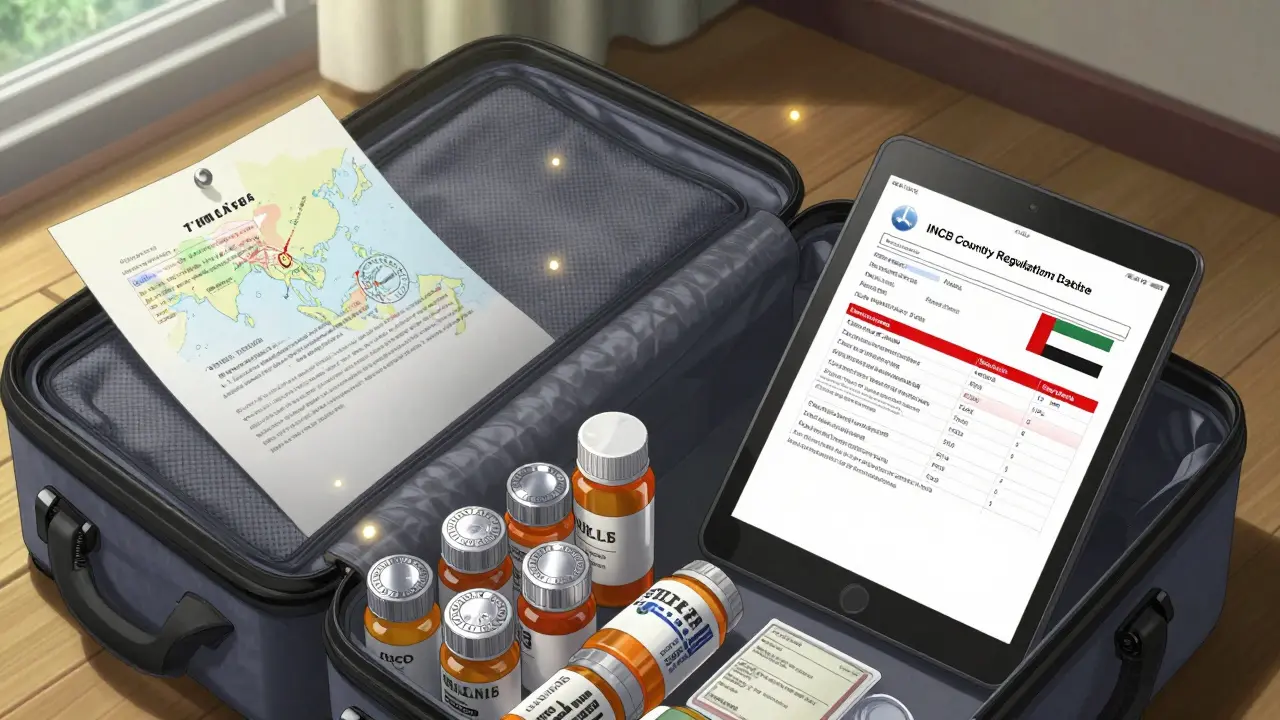
- Check the INCB Country Regulations Database (available online). It’s the most updated source for what’s banned or restricted in your destination country.
- Contact the embassy or consulate of your destination country. Ask: “What are the rules for bringing [medication name] into your country?” Get their response in writing.
- Talk to your doctor. Ask for: (1) the generic name of each drug, (2) a letter explaining your medical need, (3) a signed prescription with dosage in milligrams (not “take one pill daily”).
- Visit your pharmacy. Ask if they can issue an International Certificate for Medicinal Products (ICMP). About 68% of U.S. pharmacies offer this for $25-$40. It’s not required everywhere, but it helps.
- Double-check transit countries. If you’re flying through Dubai, Singapore, or Frankfurt, check their rules too. You can be stopped even if you’re not leaving the airport.
Real Stories: What Happens When You Don’t Plan
A traveler from Texas was detained for 4 hours at Bangkok Airport because she had 28 tablets of alprazolam in a pill organizer. No original bottle. No doctor’s letter. No translation. She was released after her family flew a copy of her prescription to the airport-but she missed her connecting flight.
Another man from Florida was denied entry into Japan because his Adderall prescription didn’t match the country’s approved dosage form. He had to fly home, leaving his wife stranded for two weeks.
These aren’t outliers. Mobility International USA reports that 45% of travelers with chronic conditions face medication disruptions. The biggest causes? Not enough supply (32%), no documentation (28%), and banned meds (24%).
Regional Differences You Can’t Ignore
Not all countries treat meds the same way:
- Europe: Within the Schengen Area, rules are mostly aligned. But France and Germany restrict ADHD meds. Bring extra documentation.
- Asia: Japan bans over 1,400 substances. Thailand requires notarized letters. Singapore increased penalties by 300% in 2025.
- 中东 (Middle East): Saudi Arabia and UAE require government permits for nearly all controlled substances. CBD products? Banned in 19 countries-even though they’re legal in the U.S.
- Canada and Australia: More lenient than Asia or the Middle East, but still require original prescriptions.

Tools and Resources You Can Use
You don’t have to figure this out alone:
- INCB Country Regulations Database (updated January 2025): Lists banned and restricted meds by country.
- CDC Yellow Book: Free online guide with country-specific health advice.
- U.S. State Department Travel Advisories: Each country page has a “Health” section with medication notes.
- INCB Emergency Line: +41 22 917 92 92 (24/7 for urgent questions).
- MedPassport: A digital app that stores your meds, prescriptions, and embassy contacts. Subscription is $49/year.
What’s Changing in 2025 and Beyond
The rules are getting tighter. Since 2020, 63 countries have added new restrictions on traveler meds. The European Union is working on a unified system by 2027, but Asia and the Middle East are moving in the opposite direction.
The U.S. State Department is piloting standardized medication forms with Japan, UAE, and Thailand-expected to launch in late 2025. Until then, assume every country has its own rules. Don’t rely on past trips. Regulations change every year.
Final Rule: When in Doubt, Bring More Paper
The easiest way to avoid trouble? Over-document. Bring:
- Original bottles
- Prescription copies
- Doctor’s letter
- ICMP certificate (if available)
- Translation of medication names
- Embossed stamp from your pharmacy (if they can provide it)
And always, always carry your meds in your carry-on. No exceptions.
If you take medication daily, your travel safety depends on what you do before you leave-not what happens at the airport. Plan early. Double-check. Ask questions. Your health-and your freedom-depend on it.
Can I bring my prescription medication in a pill organizer?
It’s risky. While some travelers get away with it, U.S. Customs and many foreign countries require medications to be in original containers with prescription labels. A pill organizer without labeling can trigger alarms at security or customs. Always keep the original bottles in your carry-on and only use the organizer for convenience during travel, not as your primary storage.
Do I need a doctor’s letter if I’m only traveling for a week?
Yes-if your medication is in the high-risk category (narcotics, sedatives, ADHD stimulants). Even a 3-day trip to Thailand or Japan requires a doctor’s letter. Countries don’t make exceptions for short stays. The letter should state your diagnosis, the medication name (generic and brand), dosage, and that it’s medically necessary. A simple note on letterhead signed by your doctor is enough.
Can I refill my prescription overseas?
Almost never. Pharmacies in most countries won’t fill a U.S. prescription. Even if they recognize the drug name, they need a local prescription. Some countries allow you to see a local doctor, but that requires time, money, and often a visa. Don’t count on it. Bring enough for your entire trip plus 7 extra days.
Is CBD oil allowed when traveling internationally?
No, not reliably. Even though CBD is legal federally in the U.S., 19 countries-including South Korea, Malaysia, and Thailand-banned all CBD products in 2024. Airports in Dubai, Singapore, and Japan routinely seize CBD oil. Treat it like a controlled substance. If you need it for medical reasons, research your destination’s rules first-and consider alternatives.
What if my medication is banned in my destination country?
You have two options: find an alternative medication approved in that country, or don’t go. Some doctors can switch you to a different drug with similar effects that’s legal abroad. For example, switching from Adderall to a non-stimulant like atomoxetine may work for ADHD. Contact your doctor at least 8 weeks before travel to explore options. Never try to sneak banned meds in-it’s not worth the risk.





Randall Walker
I once flew through Dubai with my Xanax in a pill organizer. Didn't think twice. Got pulled aside. Took three hours. They didn't arrest me, but they made me sign a form that said I'd 'voluntarily surrender' my meds. I didn't. I just lied and said it was for my cat. They believed me. Don't ask how I know this.
Bridgette Pulliam
I'm a nurse and I travel internationally every quarter. I always carry my meds in original bottles, a doctor's letter, and a printed copy of the INCB page for my destination. It's not paranoia-it's professionalism. And yes, I've had customs officers thank me for being organized. Weird, right?
Adam Kleinberg
This whole thing is just another government control scheme. If you're taking Adderall for ADHD, you're not a criminal. Why should some bureaucrat in Tokyo decide what my brain chemistry needs? The real danger is letting countries dictate your medical autonomy. They're not protecting you-they're policing your existence.
Chris Bird
Why you even take pills? Just stop. Life is simple. You feel bad? Drink water. Walk. Breathe. No need for all this paper and embassy nonsense. People make it too hard.
Mike Winter
The irony is that we live in a world where a man can carry a loaded firearm across borders with minimal scrutiny, but a woman with a prescription for anxiety is treated like a smuggler. It's not about safety-it's about stigma. We've medicalized suffering, then criminalized the solutions. The real tragedy isn't the banned meds-it's the silence around why they were banned in the first place.
LiV Beau
I just packed my Zolpidem in my purse with the bottle and a doctor's note. Got waved through at Heathrow like I was carrying deodorant 😌 I'm so proud of myself. Also, I got a MedPass app. It's kinda cute? Like a digital medicine diary. 💊✨
Denise Jordan
I read this whole thing. Honestly? I think most people are just scared of flying. You don't need a letter. You don't need a certificate. Just put it in your bag and hope. That's what I do. And I've never been caught. So.
Shourya Tanay
The INCB database is underutilized. Most clinicians aren't trained on international pharmacovigilance frameworks. We're operating in a fragmented regulatory ecosystem where patient safety is an afterthought. We need standardized interoperable documentation protocols-preferably blockchain-anchored-to ensure continuity of care across sovereign jurisdictions.
Kenneth Zieden-Weber
You know what's wild? The fact that we're having this conversation at all. We're not talking about drugs-we're talking about dignity. If your medication is legal in the U.S., why should a foreign customs agent have more authority over your body than your own doctor? This isn't about law. It's about power. And it's broken.
David L. Thomas
I’ve been traveling with insulin for 12 years. Always carry the original vials, the prescription, the letter, and a backup pen. TSA agents? They’ve seen it all. Just say ‘medical necessity’ and smile. They’ll help. I once had one offer me a bottle of water because I looked nervous. That’s the kind of humanity we still have out there. Don’t lose faith.
Miranda Varn-Harper
I'm sorry, but if you're taking Adderall for 'focus' and not a diagnosed condition, you're not a patient-you're a drug user. And if you're trying to sneak it into Thailand, you're not a victim of bureaucracy-you're a fool. This isn't a guide for travelers. It's a warning for people who think rules don't apply to them.
Gene Forte
I used to think this was overkill. Then my sister got detained in Japan for having 14 pills of Klonopin. She missed her wedding. We had to fly her prescription over. She cried for three days. Don’t wait for disaster. Plan like your life depends on it-because it does. Start now. Not tomorrow. Today.