Vitamin E and Warfarin: What You Need to Know About the Bleeding Risk
Vitamin E & Warfarin Risk Calculator
Enter your daily vitamin E dose to assess bleeding risk when taking warfarin.
Take vitamin E for its antioxidant benefits, and you're on warfarin to prevent clots. Sounds harmless, right? But here’s the problem: vitamin E and warfarin can team up in ways that put you at serious risk of bleeding - even if you’re taking what seems like a safe dose.
How Vitamin E Can Make Warfarin More Powerful
Warfarin works by blocking vitamin K, which your body needs to make clotting factors. It’s a tightrope walk: too little, and you risk clots; too much, and you bleed. Vitamin E doesn’t work the same way, but it still messes with your blood’s ability to clot. It reduces platelet stickiness, which means your blood doesn’t clot as easily - even without touching vitamin K.
This isn’t just theory. A 2013 study in the Journal of the American Heart Association followed over 1,000 people on warfarin and found that those with higher vitamin E levels in their blood had a much greater chance of bleeding. When serum vitamin E reached 4.49 μmol/mmol cholesterol, bleeding risk went up. At 5.56 μmol/mmol cholesterol, the risk of major bleeding - like brain bleeds - jumped even higher. And here’s the kicker: this happened independently of other risk factors like age, high blood pressure, or kidney disease.
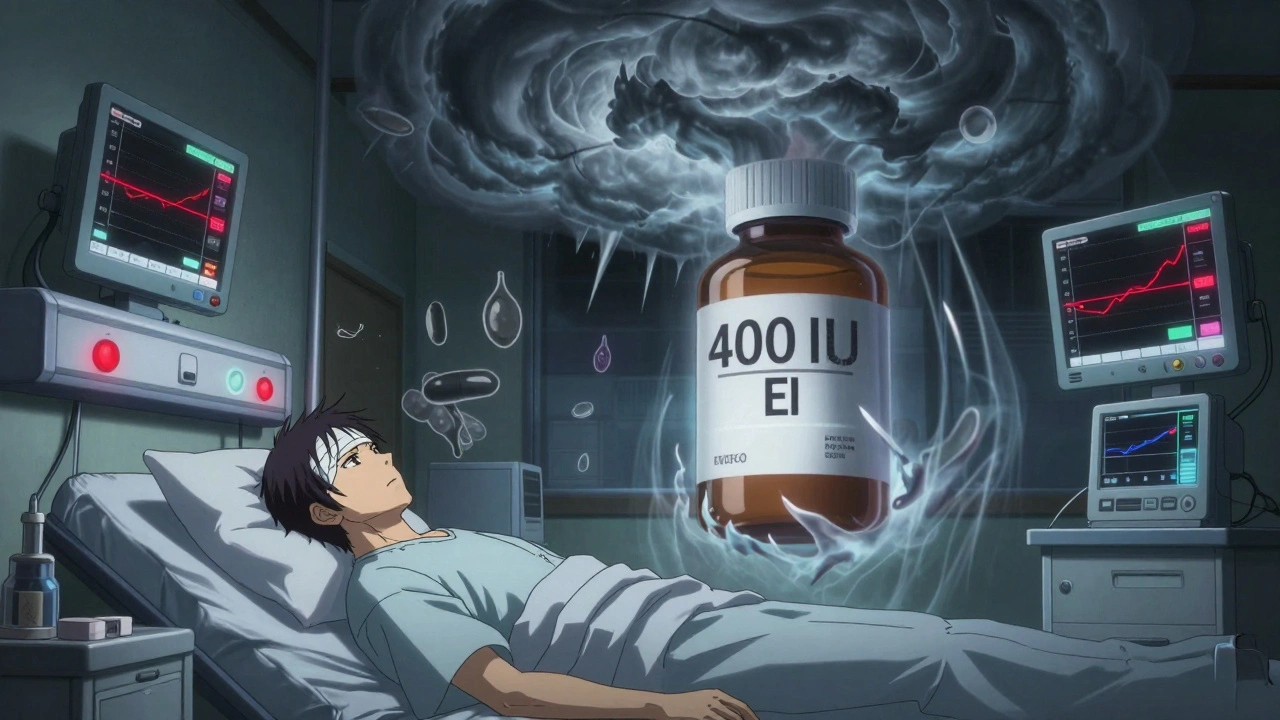
The 400 IU Threshold: Where Safety Ends and Danger Begins
Not all vitamin E is the same. Doses under 400 IU daily show mixed results. Some small studies found no effect on INR. Others, like a 30-day trial with just three people, showed bleeding risk even at 42 IU. But when doses climb above 400 IU - a common amount in many supplements - the danger becomes clear.
The American Heart Association warns that doses of 400 IU or more may increase the risk of hemorrhagic stroke, especially in people on blood thinners. The University of California San Diego Anticoagulation Guidelines say outright: avoid vitamin E if you’re on warfarin. Why? Because it adds to the antiplatelet effect of other supplements like fish oil, garlic, and turmeric. Together, they pile up.
Why Some Studies Say It’s Safe - And Why You Shouldn’t Trust Them
You might have heard about a 1996 study from UC Davis that found no change in INR when people took vitamin E with warfarin. That study had only 21 patients and lasted just a few weeks. It looked at short-term INR changes - not long-term bleeding events. That’s like checking your car’s oil light once after a road trip and deciding it’s fine to drive for a year.
The real danger? Delayed effects. One case report showed normal INR for three weeks, then sudden, life-threatening bleeding in week four. That’s why the Anticoagulation Forum recommends weekly INR checks for the first month if someone insists on taking vitamin E - and then every two weeks after that. You can’t rely on a single blood test. You need to watch over time.
Who’s at Highest Risk?
Not everyone reacts the same way. Genetics play a role. People with certain variants in the CYP2C9 or VKORC1 genes metabolize warfarin differently - and may be far more sensitive to vitamin E’s effects. Older adults, people with liver disease, or those already on multiple blood-thinning supplements are at greater risk.
Even if you’re young and healthy, if you’re taking vitamin E at 800 IU or 1,200 IU - common in “heart health” formulas - you’re playing Russian roulette with your blood. The European Society of Cardiology now recommends checking vitamin E levels in patients on warfarin who have unexplained bleeding. That’s how seriously they take this.
What the Guidelines Actually Say
The American College of Chest Physicians gives vitamin E a Grade 2C recommendation: moderate evidence, weak advice. Translation? We don’t have perfect data, but the risk is real enough to warn people.
A 2017 survey of 250 anticoagulation clinics found that 78% routinely tell patients to avoid vitamin E. Sixty-three percent specifically say: don’t go over 400 IU. The Coumadin package insert doesn’t name vitamin E, but it warns about herbal and botanical products - and vitamin E falls into that gray zone.
The Mayo Clinic doesn’t list vitamin E specifically, but they do say: “Supplements can change how warfarin works.” If you’re on warfarin, assume anything you take orally could interfere - unless proven otherwise.
What to Do If You’re Taking Both
If you’re on warfarin and already taking vitamin E:
Don’t stop suddenly. Talk to your doctor. Abruptly stopping vitamin E can cause your INR to drop, increasing clot risk.
Ask for a serum vitamin E level test. It’s not routine, but if you’ve had unexplained bleeding, it’s worth asking.
Get your INR checked more often - weekly for the first month, then every two weeks if you continue.
Check every supplement label. Vitamin E is hidden in multivitamins, fish oil blends, and “anti-aging” formulas.
Consider alternatives. Vitamin C, selenium, or astaxanthin offer antioxidant benefits without the bleeding risk.
What About Newer Blood Thinners?
If you’re on a DOAC - like apixaban, rivaroxaban, or dabigatran - the story changes. These drugs don’t interact with vitamin K, so the mechanism is different. There’s no strong evidence yet that vitamin E increases bleeding risk with DOACs. But that doesn’t mean it’s safe. Platelet inhibition still happens. Until more data comes out, it’s best to avoid high-dose vitamin E even if you’re not on warfarin.
The Bigger Picture: Supplements Aren’t Regulated Like Drugs
The FDA doesn’t test supplements for safety or interactions before they hit shelves. A bottle labeled “1000 IU vitamin E” might contain 800 IU - or 1,500 IU. There’s no standardization. And because vitamin E is sold as a “natural” product, many people assume it’s harmless.
In 2022, Americans spent $287 million on vitamin E supplements. Most people think they’re just helping their skin or heart. Few realize they might be silently increasing their risk of a stroke or internal bleed.
Bottom Line: When in Doubt, Skip It
Vitamin E isn’t a magic bullet. You get plenty from nuts, seeds, spinach, and vegetable oils. You don’t need a pill.
If you’re on warfarin, the safest choice is to avoid vitamin E supplements entirely - especially anything over 400 IU. If your doctor says it’s okay, make sure you’re getting regular INR checks and know the signs of bleeding: unusual bruising, nosebleeds that won’t stop, blood in urine or stool, severe headaches, or dizziness.
This isn’t about fear. It’s about control. You’re managing a life-saving drug. Don’t let an unregulated supplement undo that.
so like... i took 800iu of vit e because my tiktok dermatologist said it 'glows' my skin? lol. now i'm scared i'm gonna bleed out in my sleep. thanks for the wake-up call, i guess? 🤡
James Moore
December
5, 2025 AT 00:39
This is exactly why America is falling apart-people think 'natural' means 'safe,' and then they wonder why their INR spikes like a stock market crash during a pandemic! The FDA doesn't regulate supplements? That's not a loophole-that's a national security flaw! We've got doctors prescribing vitamins like they're candy, and then we're shocked when someone ends up in the ER with a cerebral hemorrhage! This isn't just medical negligence-it's cultural decay!
Kylee Gregory
December
5, 2025 AT 22:23
It's interesting how we treat supplements like they're harmless because they're 'natural,' but we'd never take an unregulated pharmaceutical without scrutiny. Maybe the real issue isn't vitamin E-it's our willingness to trust anything labeled 'organic' or 'herbal' without asking for evidence. We need better education, not just fear-mongering.
Laura Saye
December
6, 2025 AT 06:05
I’ve been on warfarin for 7 years, and I’ve always avoided high-dose vitamin E-but I didn’t know the mechanism was platelet-related, not just vitamin K interference. This post helped me understand why my INR spiked after that ‘heart-healthy’ multivitamin I took last winter. I’m going to ask my anticoagulation clinic for a serum level test next visit. Thank you for the clarity.
luke newton
December
7, 2025 AT 21:34
You people are ridiculous. You take some pill your aunt swears by, then act shocked when it kills you? You think your grandma’s turmeric tea is 'natural healing'? It’s poison wrapped in a rainbow sticker. Stop being sheep and start taking responsibility. Your bleeding isn’t the supplement’s fault-it’s yours.
Lynette Myles
December
9, 2025 AT 19:51
Vitamin E is a bioweapon disguised as a supplement. The FDA knows. The pharma companies know. They let it slide because they profit from the ER visits. Watch the next study-funded by a supplement brand-say 'no risk.'
Ali Bradshaw
December
10, 2025 AT 15:08
I’ve been on apixaban for AFib and still skip the high-dose vit E. Better safe than sorry, right? Also, nuts are delicious and free of side effects. Win-win. Keep it simple.
an mo
December
10, 2025 AT 19:32
The 400 IU threshold is arbitrary. The real danger is the lack of batch standardization. One bottle says 500 IU, another says 1,200 IU under the same label. This isn’t a drug interaction-it’s a supply chain fraud. Demand third-party testing. Or don’t. But don’t blame the vitamin.
aditya dixit
December
12, 2025 AT 15:46
In India, we’ve used turmeric and sesame oil for centuries without warfarin. But when you mix modern pharmacology with traditional supplements without understanding the biochemistry, chaos follows. Knowledge is the real antioxidant here. Stay curious, stay cautious.





Annie Grajewski
so like... i took 800iu of vit e because my tiktok dermatologist said it 'glows' my skin? lol. now i'm scared i'm gonna bleed out in my sleep. thanks for the wake-up call, i guess? 🤡
James Moore
This is exactly why America is falling apart-people think 'natural' means 'safe,' and then they wonder why their INR spikes like a stock market crash during a pandemic! The FDA doesn't regulate supplements? That's not a loophole-that's a national security flaw! We've got doctors prescribing vitamins like they're candy, and then we're shocked when someone ends up in the ER with a cerebral hemorrhage! This isn't just medical negligence-it's cultural decay!
Kylee Gregory
It's interesting how we treat supplements like they're harmless because they're 'natural,' but we'd never take an unregulated pharmaceutical without scrutiny. Maybe the real issue isn't vitamin E-it's our willingness to trust anything labeled 'organic' or 'herbal' without asking for evidence. We need better education, not just fear-mongering.
Laura Saye
I’ve been on warfarin for 7 years, and I’ve always avoided high-dose vitamin E-but I didn’t know the mechanism was platelet-related, not just vitamin K interference. This post helped me understand why my INR spiked after that ‘heart-healthy’ multivitamin I took last winter. I’m going to ask my anticoagulation clinic for a serum level test next visit. Thank you for the clarity.
luke newton
You people are ridiculous. You take some pill your aunt swears by, then act shocked when it kills you? You think your grandma’s turmeric tea is 'natural healing'? It’s poison wrapped in a rainbow sticker. Stop being sheep and start taking responsibility. Your bleeding isn’t the supplement’s fault-it’s yours.
Lynette Myles
Vitamin E is a bioweapon disguised as a supplement. The FDA knows. The pharma companies know. They let it slide because they profit from the ER visits. Watch the next study-funded by a supplement brand-say 'no risk.'
Ali Bradshaw
I’ve been on apixaban for AFib and still skip the high-dose vit E. Better safe than sorry, right? Also, nuts are delicious and free of side effects. Win-win. Keep it simple.
an mo
The 400 IU threshold is arbitrary. The real danger is the lack of batch standardization. One bottle says 500 IU, another says 1,200 IU under the same label. This isn’t a drug interaction-it’s a supply chain fraud. Demand third-party testing. Or don’t. But don’t blame the vitamin.
aditya dixit
In India, we’ve used turmeric and sesame oil for centuries without warfarin. But when you mix modern pharmacology with traditional supplements without understanding the biochemistry, chaos follows. Knowledge is the real antioxidant here. Stay curious, stay cautious.