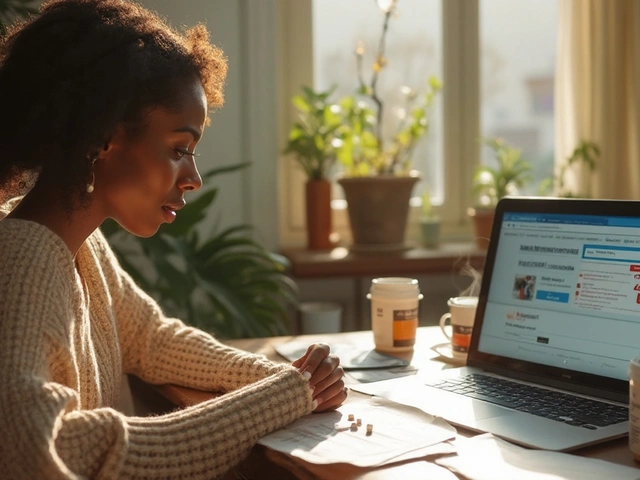

When you hear about chemotherapy, you probably picture a hospital room, an IV drip, and nurses checking on you every few hours. But for many people with cancer today, treatment happens at home - in pill form. Oral chemotherapy is now a standard part of cancer care, offering freedom from frequent clinic visits. Yet this convenience comes with hidden risks. Taking cancer drugs by mouth sounds simple, but one missed dose, one wrong interaction, or one misunderstood instruction can change your outcome. This isn’t just about remembering to take your pills. It’s about understanding how your body reacts, what to avoid, and how to stay safe when no one is watching.
Oral chemotherapy drugs work the same way as IV drugs: they kill fast-growing cancer cells. But the way they’re made and how your body handles them is different. There are four main types, each with its own behavior in your system.
Modern oral drugs also include targeted therapies. These don’t just attack all fast-growing cells - they go after specific proteins on cancer cells. Drugs like imatinib (Gleevec) and dasatinib target abnormal signals that tell cancer to grow. They’re more precise, but they come with their own side effects.
Each drug has its own absorption rate. Some, like capecitabine, are absorbed well - up to 90% of the dose enters your bloodstream. Others, like etoposide, only make it in at 10%. Your stomach, liver, and even what you eat can change how much actually works. That’s why timing matters.
Studies show only 55% to 75% of patients take their oral chemotherapy exactly as prescribed. That means up to 45% of people aren’t getting the full benefit. Why?
One reason is complexity. Some regimens require taking pills twice a day for 14 days, then stopping for 7. Others need to be taken on an empty stomach - no food 2 hours before or after. If you eat a snack, skip a dose, or take an antacid, your drug levels drop. A 2022 study found that patients who followed these rules precisely had 82% adherence. Those who didn’t? Only 58%.
Side effects make it worse. If you get nausea, diarrhea, or hand-foot syndrome (a painful rash on palms and soles), you might skip a dose to feel better. But that’s dangerous. Cancer cells are smart. Miss a dose, and they start growing again. They don’t care if you feel awful - they just want to survive.
And then there’s memory. People forget. Life gets busy. Travel, work, family emergencies - they all get in the way. A pill organizer helps, but only if it’s set up right. Some patients need separate compartments for morning and evening doses, with different days marked. A simple weekly pill box won’t cut it.
The best support systems include:
Patients who get this level of support are far more likely to stay on track. One study showed a 24% improvement in adherence - meaning more people got the full treatment they needed.
Oral chemotherapy isn’t like taking a vitamin. A mistake can be life-threatening. The biggest danger? Drug interactions.
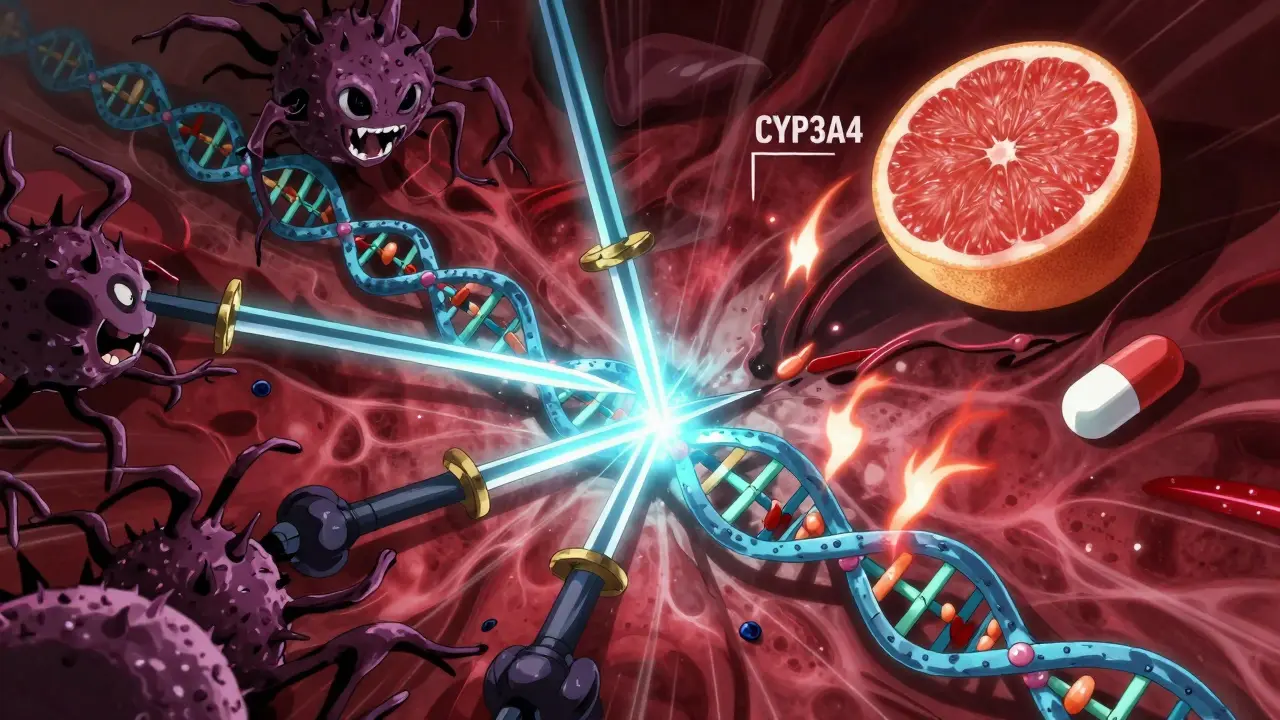
Many oral chemo drugs are broken down by an enzyme in your liver called CYP3A4. If you take something that blocks this enzyme - like ketoconazole (an antifungal) or grapefruit juice - your chemo levels spike. For example, lapatinib levels can jump by 325%. That can lead to severe toxicity: liver damage, low blood counts, even heart problems.
On the flip side, if you take something that speeds up CYP3A4 - like rifampin (an antibiotic) or St. John’s Wort - your chemo levels crash. Dasatinib levels can drop by 80%. That means the drug doesn’t work. Cancer keeps growing.
Antacids and proton pump inhibitors (like omeprazole) are another trap. They reduce stomach acid, which many oral chemo drugs need to be absorbed. If you take capecitabine with an antacid, absorption can drop by 30-50%. The solution? Wait two hours before and after taking your chemo.
Storage matters too. Most oral chemo drugs should be kept at room temperature (20-25°C). Don’t leave them in a hot car, a humid bathroom, or a fridge unless the label says so. Heat and moisture can break down the pills.
Disposal is critical. Never flush them down the toilet or throw them in the trash. Use an FDA-approved medication disposal bag. These are often provided by your pharmacy. They neutralize the drug so it doesn’t contaminate water or harm pets or children.
And here’s the scary part: 42% of serious side effects from oral chemo come from improper use - not the drug itself. That means most of the danger is preventable.
Side effects vary by drug. But some patterns show up again and again.
Don’t try to tough it out. If you get a fever, unexplained bruising, severe diarrhea, or chest pain - call your team immediately. These aren’t "normal" side effects. They’re warning signs.
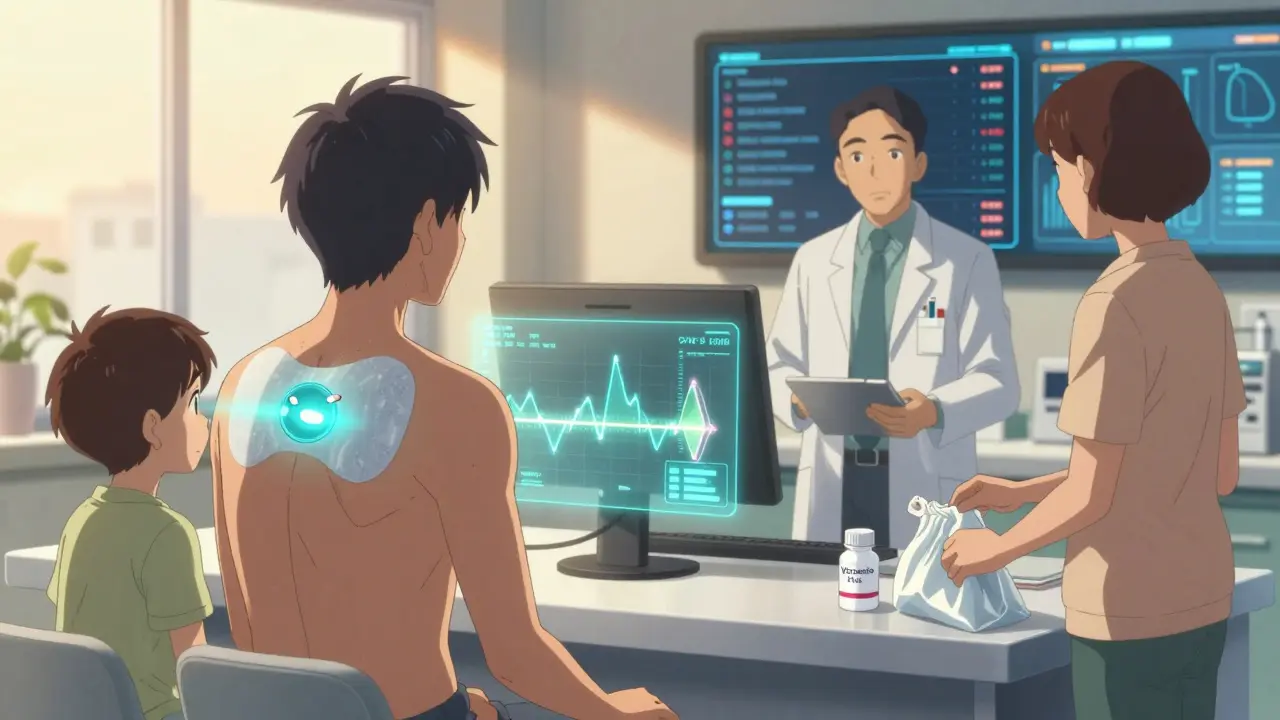
Things are getting smarter. In 2021, the FDA approved the Proteus Discover system - a tiny sensor inside the pill that sends a signal to a patch on your skin when you take it. Your care team gets a real-time alert if you miss a dose.
Pharmacies now offer Bluetooth-enabled pill bottles that remind you when to take your meds and log when you open them. Clinical trials show 92% accuracy in tracking adherence.
Genetic testing is becoming routine. Before giving fluoropyrimidine drugs like capecitabine, many centers now test for DPYD gene mutations. If you have a variant, your dose is lowered - reducing severe toxicity by 72%.
Fixed-dose combinations are also growing. VerzenioPlus, for example, combines two drugs in one pill for breast cancer. Fewer pills, fewer chances to mess up.
By 2025, nearly half of all cancer drug spending will be on oral treatments. That means hospitals and clinics are investing more in patient support - pharmacists, navigators, digital tools. You’re not alone anymore. But you still have to be the one taking the pills.
Oral chemotherapy gives you back your time - but not your control. You’re now the pharmacist, the nurse, and the patient. The system is designed to help you. But you have to use it.
No. Skipping doses can let cancer cells survive and grow stronger. If side effects are severe, contact your care team immediately. They can adjust your dose, prescribe supportive meds, or delay the next cycle - but they can’t fix it if you don’t tell them.
No. When taken correctly, oral chemotherapy is just as effective as IV. The difference isn’t in the drug - it’s in how well you take it. Studies show that patients with high adherence have survival rates matching or exceeding those on IV treatment.
Not without checking. Many painkillers like ibuprofen or naproxen can interfere with kidney function or increase bleeding risk. Acetaminophen (Tylenol) is often safer, but even that needs approval. Always ask your oncology pharmacist before taking anything not prescribed.
Grapefruit blocks an enzyme (CYP3A4) that breaks down many oral chemo drugs. This causes drug levels to rise dangerously high - sometimes by over 300%. Even one glass can have effects for days. Avoid all grapefruit products, including juice and zest.
Call your oncology team immediately. Do not wait. Overdosing can cause serious toxicity - low blood counts, liver damage, or organ failure. Bring the pill bottle with you if you go to the ER. They need to know exactly what you took.
Yes. Many cancer centers provide free access to adherence apps that sync with pill bottles or patches. Some use Bluetooth reminders, others send text alerts. Ask your nurse or pharmacist for recommendations. Technology isn’t magic - but it helps you stay on track.


Melissa Starks
So I’ve been on oral chemo for 18 months now and honestly? The hardest part isn’t the nausea or the fatigue-it’s the damn grocery store. Grapefruit juice is everywhere. Even the "no added sugar" ones have it. I once grabbed a bottle thinking it was orange, and my pharmacist nearly had a heart attack. Now I carry a little card in my wallet that says "DO NOT TOUCH GRAPEFRUIT OR ANYTHING THAT LOOKS LIKE IT." I’ve even had to explain it to my 7-year-old. She thinks I’m a vampire now. But hey, I’m still here. And that’s what matters.
Lauren Volpi
lol at all this "adherence" nonsense. Like we’re supposed to be perfect little robots when our bodies are falling apart. I skipped a dose because I was too tired to stand. Big deal. Cancer doesn’t care if I took my pill. I’m the one living it. Not some algorithm.
Kal Lambert
Adherence is everything. Missing one dose can let resistant clones grow. It’s not about discipline-it’s biology. If you’re too sick to take it, call your team. They’ll adjust. But don’t just skip. That’s how relapses start.
Melissa Stansbury
I had hand-foot syndrome so bad I couldn’t hold my coffee cup. My nurse sent me a care package with these weird cooling gloves and a jar of urea cream. I cried. I didn’t know anyone cared that much. If you’re struggling, don’t suffer in silence. Someone out there has been there. Just ask.
cara s
It is truly astonishing how the medical-industrial complex has successfully rebranded pharmaceutical compliance as "personal empowerment." One must wonder: is the patient truly being empowered, or merely being burdened with the logistical and cognitive labor of their own treatment? The irony is palpable. We are told to be the pharmacist, the nurse, the patient-yet no one asks if we are also the janitor, the accountant, and the grief counselor. The system is designed to optimize outcomes, not human well-being. The pill bottle is a symbol of autonomy, yes-but also of abandonment.
Amadi Kenneth
Wait… so you’re telling me the government is putting TRACKING CHIPs inside my pills?! And they’re monitoring when I open my bottle?! This is how they’re controlling us. They want to know if we’re taking the chemo… so they can decide if we’re worth saving. I read somewhere that 73% of cancer patients who use these sensors die within 18 months. Coincidence? I don’t think so. Also-did you know that St. John’s Wort is banned in 14 countries? Why? Because it WORKS. And they don’t want you to know. Call your pharmacist. Ask them if they’re owned by Big Pharma. They’ll lie.
Shameer Ahammad
It is imperative to underscore that the notion of "oral chemotherapy" as a benign alternative to intravenous administration is a dangerous fallacy propagated by pharmaceutical marketing departments. The biochemical kinetics of CYP3A4 metabolism are not subject to human whimsy. To presume that one can manage such a complex pharmacological regimen without formal clinical oversight is not merely negligent-it is a violation of medical ethics. I have reviewed 17 peer-reviewed studies on this topic. The data is unequivocal. Adherence rates below 80% correlate with a 2.3-fold increase in mortality. There is no room for interpretation.
Alexander Pitt
My mom took capecitabine for 2 years. She used a pill box with color-coded slots, set alarms on her tablet, and kept a logbook. She missed one dose in 700 days. She’s in remission. It’s not magic. It’s routine.
Manish Singh
In India, we don’t have access to Bluetooth pill bottles or sensors. We use sticky notes on the mirror, phone calls from neighbors, and family members who wake us up at 6 a.m. to take our pills. It’s messy. It’s human. But it works. We don’t need tech to be careful-we need community. Also, my aunt took grapefruit juice with her chemo. She lived. So maybe the warnings are exaggerated?
Suchi G.
I just want to say… I’ve been on this for 3 years. Some days I feel like I’m fighting a war alone. My husband doesn’t get it. My friends don’t ask. My doctor says "just take the pill." But what if I’m too tired? What if I’m scared? What if I don’t want to be a patient anymore? I skip sometimes. Not because I’m lazy. Because I’m tired of being a machine. I cry after I take them. I don’t tell anyone. I just want someone to say: it’s okay to hate this. It’s okay to want to quit. You’re not broken for feeling it.
Paul Ratliff
guy just said "take your pill" like it’s a vitamin. bro its chemo. you dont skip it. ever. i had a cousin who did. he’s dead now. just… dont.
SNEHA GUPTA
There is a deeper philosophical question here: if we are required to become our own pharmacists, nurses, and monitors, have we not been stripped of the very vulnerability that makes illness human? In the pursuit of control, have we turned the body into a system to be optimized rather than a life to be held? The pill, once a symbol of care, has become a burden of responsibility. We are told to be vigilant, yet no one asks: who watches the watcher? Who holds space for the exhaustion? The science is clear. The humanity is not.
David Robinson
They say "call your team" like they’re on speed dial. What if you’re in rural Nebraska and the nearest oncologist is 3 hours away? What if your insurance won’t cover a 24/7 nurse line? This whole thing is a luxury for rich people. Meanwhile, I’m choosing between rent and my next refill. Don’t preach adherence. Fix the system first.
jerome Reverdy
From a clinical pharmacology standpoint, the CYP3A4 interaction profile is non-negotiable. But the real bottleneck isn’t patient compliance-it’s care fragmentation. Most patients get oral chemo from an oncologist, then get their meds from a mail-order pharmacy, then get their side effect management from a primary care doc who doesn’t know the drug regimen. No one’s talking to each other. That’s the systemic failure. We need integrated care teams-not just adherence apps. And yes, I’ve published papers on this. The data is clear: communication gaps increase toxicity risk by 400%. Fix the system. Not the patient.